Happy Financial New Year – Five Different Paths to Money Success.

Media is flooded with pundits spouting 2014 financial resolutions. Heck, I’m on radio and television talking up the same.

talking head

Increase savings in retirement accounts, pay down credit card debt, check your insurance coverage for gaps – all good advice.

But.

We already know this stuff. It’s drilled into our heads.

Every year.

It’s fine to be reminded of the healthy financial actions we should take.

Yet, what stops us from following through?

Before you ponder money improvements for 2014, think outside the box – deviate from the worn financial paths you have attempted to walk before.

This time you’ll succeed if you take five different paths.

1). Don’t save everything for retirement. You read it right. It’s been drummed into you how a secure financial future depends on maximizing contributions to tax-deferred options like 401(k) accounts.  But how important is it, really?

A.J Leon, writer, motivator, world explorer, big thinker, in his book, “The Life and Times of A Remarkable Misfit,” outlines 16 simple steps to make money and lose respect – Step 4 is: “Never invest in yourself. Instead sock every last penny in a 401(k) that may or may not be there to greet you when you turn 65.”

Many employers have a difficult time understanding retirement plans. From the hundreds of plans examined, I notice an overwhelming trend of bland choices coupled with high fees.

For some it’s best to settle on government-approved choices called “target-date” funds. They’re the prevalent cookie-cutter choices in your company retirement plan. Basically, they’re an all-in-one mix of mutual funds packaged and wrapped in another mutual fund, thus called a “fund of funds.” The mix of stocks, bonds and cash is designed to match up to the year you decide to re­tire.

For example, it’s 2012 and you’re 40 years old. You are planning to retire at 65 (good luck). You decide on the “BlahBlah Fund 2037.” Easy.

The logic behind a target date fund is simple even though underneath, the design is com­plicated and investment philosophies can deviate dramatically depending on the mutual fund family your employer utilizes. In other words, the returns of the Blah-Blah Fund 2037 compared to the returns of your buddy’s La-La Fund 2037 will most likely differ, some­times radically.

Let me clarify: Each fund creates a “glide path,” which means the blend of investments should gradually become less aggressive the closer one gets to retirement or the target year.

Per research by Zvi Bodie, the Norman and Adele Barron Professor of Management and Jonathan Truessard, Lecturer, both at Boston University in a 2007 paper “Making Investment Choices as Simple as Possible: An Analysis of Target Date Retirement Funds,” target date funds are approximately following the well-known rule of “100 minus your age,” for the stock portion of the mix. And this smelly piece of financial dogma needs to be abolished. Now.

Target-date funds require refinement. For those who invested their tax-deferred dollars in 2008 target-date options, hoping to begin withdrawing the money in 2008, were in for a rude awakening when their accounts suffered by over 21%.

Consult an objective financial advisor; select a balanced fund. If your choices are limited to the target-date variety, cut the “maturity” date in half.  Your estimated retirement date is 2020. That’s six years away.  Go for fund 2017. Be prepared for a 2008 surprise.

Contribute up to the employer match. Don’t leave free money on the table regardless of choices, either.

According to Federal Reserve data, the average U.S. household maintains an outstanding credit card balance of over $7,000. Based on numbers provided by www.bankrate.com, the average annual percentage rate or APR for variable-rate credit cards stands at 15.37%; fixed-rate cards stand at 13.02%.

Maybe, just maybe, your 401(k) account returns exceeded 13-15% in 2013 so it was worth carrying a credit card balance. Long term, it’s a bad financial choice. Instead of maxing out saving for retirement right now direct financial resources to pay credit card debt off in full.

2). Consider your human capital. Quantify your worth. You are your greatest investment. I know it’s tough to think this way, to choose yourself, but it’s true.  Return on self-investment is wealth yet to be achieved.

How will you increase your value in a challenging marketplace? Perhaps it’s a new skill necessary to move ahead and above a nascent U.S. economic recovery.

If a continuing education opportunity exists or improvement options are available to increase your income, do it. You’re probably never going to retire anyway and when you do decide, it’ll be much later than age 65 so maximize the ROY (return on you) today.

Check out a Human Capital Calculator here.

3). Get your head straight.  My friend Shanna and I discussed this topic, recently.  If you are jealous of those who have prospered financially and you communicate negative sentiment to others, you’re digging a toxic mindset hole that will be tough to escape.

Don’t talk yourself out of empowering money habits. It’s the lazy way out. Jealousy is an energy sucker, a cash drainer. Change your mind set in 2014. Your brain will believe what you repeat to yourself, to others.  Ask more questions of those you “envy:” How did you meet your goals? What are the daily habits you follow to gain greater financial independence? What did you learn from your mistakes? Learn from others, don’t push them away.

jealousy

Teacher, mentor, investor, best-selling author James Altucher advises:

“You have a house. You need to keep the house clean so the right guests can arrive and feel comfortable. If you clutter it with anger or envy or scarcity or fear then abundance won’t feel comfortable moving in. I say this not from a position of comfort but because when i was dead and buried, i had to clean the clutter to make my life work. And it was hard because when the house is cluttered, your mind gets depressed and lazy.”

4). Stocks are not an end-all investment. Don’t be pushed into believing stocks are the panacea the financial industry tells you they are when it comes to fighting inflation. According to Jim Otar, creator of the Retirement Optimizer and author of several books on retirement planning expanded on this topic for a recent interview:

“Many advisors are under the assumption that stocks always beat inflation. This is not true. Equities beat inflation only during the long-term bullish trends, which occupied 43% of the last century. During the remaining 57% of the time, equities did not beat inflation.”

Rental properties, oil & gas interests, angel investing (can be RISKY), inflation-linked securities, deferred-income annuities can also battle inflation and diversify a stock portfolio.

5). Stop the competition.  I hear it often: My friends are the same age and they have: More cars, more savings, more stuff.

Stop.

First, friends embellish.

It’s called the endowment effect.

Second, your best financial life begins today.

Don’t look back.

It’s never too late.

Third, forget the stuff.

Travel lighter.

Down five alternate paths.

And discover long-lasting financial success.

financial success

Two Depths of Red – 5 Ways to Score Salvation.

“Red is love or mean, nothin’ in-between.”

Renee – Fourth grade.

She gasped at the trickle.

Maroon and warm. And it cast a cold chill down my back.

Hurts inside when a crush observes you getting crushed.

knocked out

My best friend at the time (who is now an award-winning NYC playwright, director), told me after class how they all watched. Stunned. Subsequently, several classmates became victims to teacher bully.

Although I believe I was the one special enough to donate blood to the cause.

Bullies are always red, by the way.

red bully

A pin dropped in science class. Quiet. Like liquid-flooded ears. Sound proof, lead-drenched painted walls of a New York City public school insulated my shame.

Dead silence within a late afternoon when classes are anxious for the 3 o’clock to bell to cut through the noise of nothing.

A trickle of rosewood warm from the left corner of my mouth.

Splatter soaked up chalk letters on the board, pooled under a white “e” and dripped streams, now purple in color as red and black of board blended.

I felt her green eyes on the back of my neck.

I observed the blood of shame, too.

And did nothing.

But take the hit.

“Look you little shit – you bled all over my shirt!”

little shit

I vividly recall.

The score in my head.

The rhythm of rage that pulsates in the brain.

Sharp flares of electric crimson. Deep within a place. A red space.

consumed

The one teacher whose name I’ll never forget. Evil who physically and mentally abused several kids, including me – and we never told. Nothing was ever done to stop him. We didn’t talk. It was best to remain silent about these kinds of things back then.

A Tuesday I was afraid to answer a question, stuttered, as he dragged me over a desk by my left arm, to the front of the class and smashed my face against some scientific chalk scribble.

Hot anger burned me.

It’s cooler now. Frankly, what remains after decades, is smolder of a thought scarred by embarrassment; although memory of the event is a tinder I work to contain.

On a positive note – The devil died last year.

Too bad it wasn’t sooner.

To lessen the weight of the fire-brick in my head, flames were contained. Focused on other things.

I needed to convince myself the abuse wasn’t my fault.

And actions I’m not proud of, were taken.

To move on.

To dilute red.

To right a wrong.

black red

“What the $)@)% is up with the front door?

Dad – 1971

Poor Leon the superintendent.

He was so gracious (and super). A man with a heart of gold. A janitorial giant.

When my mother insisted the front door of our tiny Brooklyn apartment be painted shiny deep red as opposed to blackish-green like everyone else’s, he reluctantly obliged. He was like that. Couldn’t say no to people smaller than him (and most were smaller).

He should have said no.

I asked him. Pleaded.

No, really.

We didn’t require the attention.

For someone who said she didn’t like the spotlight, mom sure did love the shiny-bright conversation red created.

red door

Rows of dark ways on hinges. Suddenly: A lust-red pop of color.

The red door with the golden peephole became talk of the neighborhood.

Red seeks attention, too.

And once red is released, it leaves embers that dance around you like fireflies which never lose their glow. When red lands on you, you’ll wince. For a second. Then you’re ok, again.

Although a second can turn to years. Decades.

Random Thoughts:

1). Red is love or mean, nothing in between – Red represents the best and worst  inside us. It’s an orgy of love demons, the dancing cadre of hate devils we need to recognize as red forms from the strongest of emotions. I’ve learned to befriend my reds,  consistently acquaint them with cooler cools to direct impact. I’m human. I fail a lot. I’ve learned to recognize red-flames rising; now I know where to go and how to channel the heat. Best to pick up on the teachings of those who drench lives with cool colors like Kamal Ravikant.

2). Red is passion. Or a prison. You choose. Best to direct energy to passions which will take you to new highs, lighter shades. In Random Thoughts, I deem Kevin Carroll a muse, a motivational force. Kevin is the author of Rules of The Red Rubber Ball. The ball is a bounce of passion, the stuff that drives you, the lessons that attach you to the teachers who elevate (and not bash your head in).

Kevin writes in such a fun way. His words explode in the ruby-red of passion.

I carry his book in my computer bag. I purchase copies for those in my inner circle (still in expansion mode). When I’m discouraged, pissed off,run over, his sentences inflate me. They add pure oxygen and life.

Red was different in Brooklyn, 1973.

For my mother, the apartment door was a prison. She kept closed, locked and tight behind red.

Afraid of getting smashed by the world, so never experiencing it. The door seemed to experience quite a bit, however.

Tough choice.

Yes, red is a prison, If you allow it to be.

Don’t let it be.

red prison door

3). To grow, you must bleed. The words of the great James Altucher. You’ll bleed to move forward, learn, become aware of the present, shed the past, not worry about the future. No avoiding the blood. You must admit and share your failures, your pain, to grow, help others grow.

Red is also the blast-furnace of fear, anxiety. High blood pressure.

James:

“Sometimes I feel like I’m engulfed in red flames. I don’t want to be afraid or anxious any more.

There are two banks to the river: on one bank are all the regrets, guilt…past.

On the other bank are all the worries, anxieties…future.

I lived most of my life on the bottom of the river, clinging to my fears of being swept up by all the currents. It’s hard to let go. I was afraid to crash into the banks. Everyone else around me was scared also.

But the only way to get to the ocean is by letting go of the fears and anxieties. By not clinging to what was stolen so you can enjoy the energy that is yours forever.”

You must allow red to roll over, swallow you. Awash in it. Then let red spit you out. Don’t fight. Resistance does not help – it creates small slits that become gaping wounds. Big damage. I know.

Once you’re aware of red, let it hit, smash your face.

There, there. It wasn’t so bad.

red face

4). Red in doses. Not so bad. A bit of anger won’t destroy. Actually, it may motivate you. When I found out that devil teacher died, I made it my business to call his family and explain how glad I was he was dead. I shared with them what he did. How he inflicted pain on others.

I know. Horrible.

But necessary.

I thanked them.

Because the anger for this man pushed me harder. When I was young, I needed to prove him wrong. When he told me I was stupid and wouldn’t amount to much, it stuck like a red sharp in my gut. He never knew when I succeeded. I did. That was enough.

His black nature created red motivation.

5). The red in your portfolio can mislead. Investors dislike the red of loss; many become frustrated when investments don’t work out. Understandable. As we hate losses twice as much as we enjoy gains, red signifies lost money, dwindling net worth. This year, there’s red in bonds and emerging markets which means frustration. Don’t overreact. Examine and adjust. With bonds, make sure your duration (a measure of interest rate risk) is three years or less. An objective financial partner can help you prepare for a rising interest rate environment (which can cause deeper reds in ’14 depending on your mix of bonds).

Emerging markets have not worked. Emerging markets bonds are priced attractively but have been my red stain in ’13. I will consider adding to them in the new year.

Michael A. Gayed, CFA, Chief Investment Strategist and Co-Portfolio Manager at Pension Partners, LLC., makes the case for emerging markets in a recent article for MarketWatch.

Great Convergence of 2014: U.S. and Emerging Markets.

Red saves, cleanses, burns out. Burns up.

But be careful.

Because red can kill.

Or save.

Pick the path.

Red is a winding road,

Coveted by flame.

A color that sets your mind ablaze.

For the good. Or the bad.

You’ll be glad to tame the dread,

And channel the turmoil,

the red in your head.

red road

Year-End Financial Planning Tips. And a Life Lesson.

Another year.

Gone.  

2013 is history.

Well, almost.

I’m glad.

For me, it is a year to forget. Too much physical, financial and mental anguish.

But their were (are) lessons.

Always. Lessons.

A friend I lost this year asked me – “Must everything be a lesson?”

Well, duh.

lesson

Now I understand why she’s a former.

Let’s wrap up 2013 (good riddance) on a solid financial note.

Here’s how.

Random Thoughts:

1). No need to rush – Among your employer benefits choices, there’s an account you direct money into each pay check. It’s called a “Flexible Spending Account” or FSA for short.  It’s a good thing because it allows you to pay for qualified medical expenses using pre-taxed dollars.  At the end of the year, many of us are in a mad scramble to spend the remaining proceeds in an FSA because it’s been a “use it or lose it” situation. In other words, if you didn’t spend the money before the end of the year, you lost it. Not anymore.  In October the U.S. Treasury Department relaxed the rules. Employers now are able to allow participants to carry over up to $500 in unused funds into the following year.

2). Are you charitable? – The qualified charitable distribution expires at the end of 2013. If you’re at the age where you’re taking required minimum distributions from your retirement accounts, you can still receive a deduction for donations you make directly to qualified charities. Consult a qualified tax adviser to take care of this one. Depending on your household income, you may benefit greatly from implementing this strategy.

3). Clean up. Now is the time to get financially organized.  Consider shredding all financial and tax documents greater than ten years old. The rest of your documents should be organized and placed in binders with tabs.  Make sure to communicate the location of important documents to those who help you make financial decisions or those who would be there if you become temporarily disabled.

4). Rebalance your portfolio. Have you ignored your 401(k) investments? Are you cash heavy? Many investors are.  Meet with an independent financial advisor for a written plan customized for you. Speak to a representative of your employer-provided plan about something called “auto-rebalancing” where investments are bought (low) and sold (high) at least on an annual basis. Work to increase retirement savings by 1% from the first pay you earn in 2014.

5). Review your holiday spending.  At the end of each year, I do a brutal self-assessment to determine how and why I perhaps went over budget and compare my spending to the previous year. For some, this is a wake-up call as you become accountable to yourself for overspending.

It appears American consumers have become smarter about taking on debt during the holidays based on a recent survey by the Certified Financial Planner Board of Standards.

New Survey Reveals American Holiday Traditions: Financially Smart Gifting and Receiving.

6). Write your two-year plan.  AJ Leon, an inspirational character who classifies himself as a “misfit” has figured out how to get the most out of life. His essays in a body of work titled The Life and Times of a Remarkable Misfit, are inspirational and more. If you seek to change your perspective, the free download is a must read.

AJ asks you to become accountable to yourself, your dreams. Write at least 500 words about where you want to be in two years. Once complete, send that gut-wrenching piece of work in an e-mail to someone who will hold you accountable. Now your aspirations are out there. Exposed.

You’re committed.

There’s no going back.

And 2014.

Will be it.

Yours.

The year you waited for your entire life.

brass ring

Go for it.

Command Your Own Drones to Financial Success.

What public relations genius!

Jeff Bezos, the CEO of Amazon, made huge media headlines by suggesting the future of light package delivery may be completed by drones as opposed to the normal, albeit boring methods of delivery we all know now.

amazon drone Um hi!

I wondered.

What the heck is a drone?

funny drone

I know – seems obvious. But is it?

An unmanned aerial vehicle:  The flight is controlled either by computer or remote control of a pilot from a remote location.  Some can fly as high as 50 thousand feet and go supersonic.

Wow.

Got me thinking…

Financial success is automated activity from 50,000 feet above your wallet. Cutting out that extra latte is not going to make you wealthy; placing as many good money habits as possible on auto-pilot is the key to financial stability.

Here are some ideas on how to command your own financial drones to success:

1). Budget on auto-pilot.  When you budget on a daily basis it’s tough to feel the positive. It feels like dieting. Or dating. Or root canal. Keeping track of expenses manually is admirable. However, it’s inevitable you’ll give up because you’re human. You have a busy life. Even if you’re proficient at manual tracking, you won’t be able to effectively interpret your long-term spending habits. Analyzing longer-term spending trends (at a higher altitude) will expose where you need to make real improvement.

Budgeting is boring; many won’t continue for long. Take your analysis to a higher level and place on auto-pilot through www.mint.com. Mint allows you to accomplish three things: See where your money goes, make budgets to stay on track, and set financial goals for the future. Mint connects to your bank accounts and updates automatically. It’s free and safe as Mint utilizes bank-level encrypted security.

Easy-to-read graphs allow you to track spending, income, net worth and account balances over time.  After a couple of months of activity, sit with an objective financial partner. Together, create a game plan to cut the expenses that will make an impact to your bottom line.

Go ahead. Enjoy your fancy coffee. For now.  Mint will track your addiction!

2). Pay yourself first.

Don’t roll your eyes.

eye roll

You’ve heard this one before, right?

The best financial rule (and I’m critical of most financial rules of thumb) is easy to follow and from a higher altitude, or the long-term, will result in a substantial positive impact to your bottom line. Before expenses are paid, before you treat yourself to a movie, it’s important to save money for emergencies and for your future – FIRST.

How?

3). Set savings on auto-flight:  Pay yourself by initiating instructions to move three percent or more into a company retirement account every pay period.  Ask your HR department how to accomplish this simple task. Do the same by establishing instructions to automatically transfer a specific dollar amount, say $25 bucks a month from your checking account into savings.

4). Go stealth on a savings target: Every three months, increase the dollars directed from checking to savings by $10. Select an amount that works for you.  Think under-the radar increases.  Barely noticeable; yet over years, this tiny habit will result in big change (and dollars). You will look forward to saving money because you’ll realize how painless it is!

Forget buying more stuff you don’t need by drone delivery.

Now’s the time to establish your own small army of financial drones.

And fly your own path to financial success.

dont drone me

The Tolle of the Governor: 6 Steps to Rebirth.

“Been on the road a couple of months.”

“By yourself?”

“Yea.”

“Where did you live before that?”

“I was in a town.”

“Were the monsters there?”

“No.”

“It was safe. Full of good people.”

“What happened?”

“He just – lost it.”

“Who?”

“Man in charge.”

“I barely made it out alive.”

Brian Heriot aka “The Governor – Philip Blake.”

governor beard

As you rip from the past, forge a path to the present, there’s a good chance the man in charge will unravel.

Actually, it’s guaranteed.

There will be.

A tumble, a spiral down, to discover who you really are inside.

And burn out what’s haunting your sleep.

Because fire cleanses.

Extinguished fires leave imprints.

Black stains scar foundations.

governor burn three

I’ve learned to fear and respect fire of the mind. 

You won’t notice change; at the surface you’ve built high fences. However, underneath, today’s thoughts are directing steps to a place you must go.

Actions will eventually get you where you need to be.

First you’ll stagger.

Over time, your gait will firm.

Deeper strides begin.

You don’t look back any longer.

Perhaps you’ll change your name to a person who was loved once.

brian heriot

Take on a new identity.

Not an issue. Whatever it takes. You do it.

Because a free mind can’t be shackled.

And ego is loosening the grip.

Yep: To gain a second chance at life you must die first. A piece of you must pass. In the worst case, an organ will be sacrificed. An element of your sanity, or stamina go to black.

You’ll fight until exhaustion.

Thrash.

Until death overtakes you.

You understand (finally).

There’s no other choice.

If you want to survive.

An enriched life dwells in acceptance, not resistance.

“Death is a stripping away of all that is not you. The secret of life is to “die before you die” — and find that there is no death.”
Eckhart Tolle

When my father was in the care of hospice and dying one cancerous internal a minute, I wanted to accelerate the process somehow. I thought of insidious ways to fast-track his departure. There was red behind my eyes. I couldn’t understand why he needed to suffer.

I didn’t want to understand then how we all must suffer.

To climb to higher places.

Grow.

I was mad at dad for leaving. I hated how I held his hand for ten hours and for five of them it felt like gripping flesh ice.

He always did the opposite of what I thought he should.

As the man in charge he drank too much, womanized too much, worked too much.

Holy shit.

As the man in charge you do it, too.

Rain blood on the closest ones.

Splatter some on yourself.

And it never.

Washes off.

The man in charge forced rules you lost interest in a long time ago but still followed; you couldn’t understand why you carried them with you for so many decades.

Maybe the space felt comfortable even though it worked against your spirit.

It’s the clash. A battle. Between past and present. Ongoing.

And in acceptance you admit.

Finally.

You were indeed, the man in charge.

Suckered, duped, stupid, evil, resentful.

All you.

Good or bad. That was you for a time. A system-based creation from endless approval of others and false control – courtesy of ego.

Because you couldn’t control outcomes. You couldn’t accept the rejection, the change, the spin of the earth, until damage was done –

It’s not fight or die.

It’s fight, THEN die.

Your inner self, perhaps who you were as a child, was a pale light in the distance that eventually got snuffed out.

Realize..

You can only lose something that you have, but you cannot lose something that you are.”
Eckhart Tolle

And a new man in charge emerges.

Out of the shatter.

Wakes up reborn.

Carrying new rules.

Stripped of ego.

Steeped in humanity; seeded from insanity.

New choices.

A higher self.

Rebirth.

And so it was for Philip Blake.

And so it can be for you.

Random Thoughts:

1). Be re-vulnerable. Look – I created a word. Crash through the high walls. Allow vulnerability to live again. You’ll need to practice. High fences just don’t fall. You’ll need to consciously drive through them every day. I’ve learned to be open to and aware of those around me. I’m more charitable. I direct my anger toward evil entities. I drop people who suck my energy. I hug my daughter from somewhere beyond my heart.

vulnerable governor

2). Become re-acceptable. Of yourself. Who you were before you lived for the approval of others who held the power, but little substance. Through nurturing your own self-acceptance, you will become accepted by others. At least the “right others.” As Srini Rao writes and teaches in his best selling new book – The Art of Being Unmistakable: A Collection of Essays About Making a Dent in The Universe –

Accolades, awards, recognition and validation may never come. In addition, ironically, when you finally stop giving a shit about them, they seem to come in abundance. Be your own gatekeeper, tastemaker, and connoisseur of what matters. Do not choose yourself so the gatekeepers will choose you.

3). Seek re-energy. Living in the past saps energy. The present creates passion, excitement. It’s full of oxygen. Focus on a present moment. No matter how small. Step into it. You’re not your parents, your co-workers. The past does not define who you are right now at this moment.

“Awareness is the power that is concealed within the present moment. … The ultimate purpose of human existence, which is to say, your purpose, is to bring that power into this world.”
Eckhart Tolle

4). Relish replenishment. Sure, investing is sexy. Financial media touts sexy all the time. Sell Apple, buy Tesla. Nothing sexy happens without the boring act of saving money, replenishing financial coffers. In the new year, increase your savings rate by 1 percent. Haven’t started? That’s the past. This is the present. Begin an auto-savings plan today. Now. Direct at the minimum, 1 percent of your take home pay into a savings account.

5). Cherish those who re-new. Who are the people who renew and revive you? You need more of them. You need to appreciate and fight for those who renew your spirit. Those you love. No matter the disagreements. If I love someone I tell them. Why hold back? Life is too short (especially in a zombie apocalypse).

family

6). Know when to re-unleash hell. It’s inevitable. Sometimes you will need to fight the enemy. You also need to know if you’re the enemy. Focus energies on what’s required to overcome obstacles. Roll a tank over your ego. Occasionally, that’s a challenge for The Governor.

Although he does try.

He’s got some work to do.

Noted.

governor tank

Look up.

A pale light glows brighter.

Dark clouds fade.

Self-redemption is yours for the taking.

Accept the past. You can’t change it.

It’s a prison.

Accept the present. It’s yours to take.

Now.

Step.

“Your outer journey may contain a million steps; your inner journey only has one: the step you are taking right now.”
Eckhart Tolle

Reversion to the Mean is a Bitch – 3 Ways to Avoid Getting Killed When The Next Market Pullback Occurs.

Dear friend and teacher Lance Roberts’ writings get my attention.

Admittedly, his work feeds my confirmation bias as we tend to agree on most topics, especially when it comes to stock market valuations, the macro-economic climate, reversion of averages and most important – the mistake of benchmarking a portfolio to a market index like the S&P 500 or as I call it:

“My brain and ego are both bigger and smarter than the market as a whole.” 

dumbass

Investment managers who claim to consistently beat the market also will boast how they’re above-average drivers, lovers, parents.

Bull.

Avoid them.

It’s this kind of performance-based thinking (or lack of it) that seduces investors to take portfolio actions based primarily on greed. Or fear. Most investors generate above-average returns, didn’t you know?

Until the math is done to prove how well below-average their returns are.

Some compare their lousy returns to a friend’s (embellished) performance and grow frustrated enough to place their risk tolerance aside and create portfolios which are too aggressive for their nature. At the first sign of market pull back I’ve watched these investors sell everything and ostensibly suffer unnecessary losses.

As people we are bigger than life in our own heads.

big head

It’s that kind of myopic ego-based bullshit that can take over the mind of a money manager who then takes on more risk at the wrong time. And if your money manager is getting increasingly aggressive NOW, then this is the WRONG TIME.

And it’s with your money.

Lance’s recent piece 30% Up Years: The Case For “Cashing In” resonates with me.

The writing doesn’t need explanation – it’s perfect as is. It requires an awareness. The messages shouldn’t be minimized even though we are in a favorable market environment which is based in part on seasonal factors along with money managers’ desire to play “catch up” on returns as they close out the year.

In other words, we have moved beyond fundamentals into momentum territory. Just be aware!

caution

It’s ok to participate if you understand what’s driving stock returns. If you believe it’s primarily fundamentals, you should stay out now. Stick with short or ultra-short term bonds and go live your life. Be happy.

Don’t fool yourself.

At this later stage of a cyclical bull market, self-denial, hubris and financial industry media will get you in trouble.

Investors and their financial partners must remain vigilant of risks of markets drunk on unprecedented Federal Reserve policies and publicly-traded corporations who continue to book record profit margins by treating employees like indentured servants.

In case you’ve been under a rock: Corporations survive solely to placate shareholders and buy back shares.

Employees and customers have limited influence on senior management. It’s worse since the financial crisis.

As former U.S. Secretary of Labor Robert Reich lamented recently through social media:

A few decades ago, when American companies were still American and when corporate profits still bore some relationship to the wages of most Americans, the nation fretted over the “competitiveness” of U.S. corporations. But now that the stock market has gone through the roof while most Americans are in the cellar, that old worry seems a bit quaint. For example, Walmart, America’s largest employer, …is highly competitive internationally. Yet it claims it can’t afford to pay its U.S. workers more than the miniscule wages it doles out to them. The claim is dubious. According to data compiled by Bloomberg, Walmart has bought back about $36 billion of its stock over the past four years, and in June announced another $15 billion of stock repurchases. The effect is to bolster the value of the remaining shares of stock.

Corporations will overwork labor and continue to perpetuate wholesome corporate philosophies driven underneath by limited vision, anemic research and development, and an ongoing fear that’s pumped into the brains and hearts of their employees.

The message by middle management remains pervasive: “Be thankful you have a job,” is still heard in meetings (I’ve asked. I know). The words are considered “motivation.”

Unfortunately, many workers are too frightened to leave or are saddled with too much household debt so they continue to languish in their soul-sucking corporate positions.

Perhaps your employer is different.

cubicle death

Uh-huh.

Hey, as a money manager, I love it!

It’s one of the reasons, even though I’m cautious, that markets can continue to do well through the end of the year and first quarter of next. 

At this mature stage of a cyclical bull market, it’s important to avoid allowing your hubris to go haywire. Don’t believe you’re just so damn good, your next goal should be to “beat an index.”

Here are Lance’s rules as to why it’s impossible (along with my commentary); I’ll add three ways to let keep yourself in check as markets eventually revert to a mean:

“While Wall Street wants you to compare your portfolio to the ‘index’ so that you will continue to keep money in motion, which creates fees for Wall Street, the reality is that you can NEVER beat a ‘benchmark index’ over a long period. This is due to the following reasons:

1) The index contains no cash. And you should always have cash. Cash is an asset class, cash is for withdrawals, cash is the ultimate diversification, cash is there to make attractive purchases.

2) It has no life expectancy requirements – but you do. Stocks for the long term? Can you wait 30 years to break even when you purchase at lofty valuations? NO.

3) It does not have to compensate for distributions to meet living requirements – but you do. You also should maintain two years worth of distributions aside for living expenses in retirement.

4) It requires you to take on excess risk (potential for loss) in order to obtain equivalent performance – this is fine on the way up, but not on the way down. Losses are tougher to make up. If you lose 50% you’ll need 100% to get back to even.

5) It has no taxes, costs or other expenses associated with it – but you do. If you invest you’re gonna have fees, commissions. There is no free lunch when it comes to expenses.

6) It has the ability to substitute at no penalty – but you don’t. Commissions, taxes will drag on returns.

7) It benefits from share buybacks – but you don’t. On occasion you benefit from a stock that now has better EPS due to buybacks, however, there’s no consistency to this for you.

In order to win the long term investing game, your portfolio should be built around the things that matter most and beating an index isn’t one of them. It’s great for cocktail party conversation around holiday season, but that’s about it. 

Here’s what’s important. Never forget:

* Capital preservation (A lost opportunity is more easily replaced than lost capital).

* A rate of return sufficient to keep pace with the rate of inflation.

* Expectations based on realistic objectives. (The market does not compound at 8%, 6% or 4%. Losses destroy the effects of compounding returns). 

* Higher rates of return require an exponential increase in the underlying risk profile. This tends not to work out well.

* You can replace lost capital – but you can’t replace lost time. Time is a precious commodity that you cannot afford to waste.

* Portfolios are time-frame specific. If you have 5-years to retirement, but build a portfolio with a 20-year time horizon (taking on more risk), the results will likely be disastrous.

Three ways to avoid losing your ass, right now:

1). If you must commit capital to stocks 5 years after the financial crisis, go SMALL. Let’s face it: You missed the big ship. Go for the dinghy and be happy. Keep your stock allocations below 50%. Keep the rest in short term fixed income or yes, cash.

2). Work with an advisor who will calculate your required return. To meet a personal benchmark. THEN WORK BACKWARDS into the asset allocation plan. Most financial consultants are there to sell you product, not to calculate your desired return. And remember generating return takes work on your part, too – Increased savings, lower debt-to-income household ratios. working longer. There’s no sexy magic here. If you’re being sold an investment first: WALK. 

3). Now is the time to stop listening to friends and family about stocks. The extremes in sentiments will confuse you. Aunt Millie sold out in 2009 and won’t go back. She’s awaiting the “big one,” the crash.  Joe went “all in” two years ago and is up a billion percent. There’s a happy medium. Cut the noise. Create rules, work the numbers. Understand where you are behaviorally when it comes to risk. Does your adviser assess you behaviorally or utilize some bullshit risk tolerance questionnaire which tells you nothing about yourself.

Pay the 40 bucks, take the test and bring the results to your advisor. Most likely, you’ll need to do this before you sit with a financial pro.

Finametrica.

As Lance writes so perfectly: “The index is a mythical creature, like the Unicorn, and chasing it takes your focus off of what is most important – your money and your specific goals. Investing is not a competition and, as history shows, there are horrid consequences for treating it as such.”

Be thankful for good advice this year.

Know your limitations.

Accept who you are from a risk perspective.

Work with an objective financial partner who listens to you.

And get your ego out of your portfolio.

ego

Ribbons of Green – 5 Ways to Wrap Yourself In Green and Find Happiness.

The wind of positive change swirls green around me.

In circling ribbons of warmth and awareness.

Acceptance.

acceptance

Green gets it. Green believes even when you refuse to. Green is faith undetected but always present. Green knows you’ll find your way out. To the green.

Green shoots live in the actions you remain steadfast to pursue, even when they feel tiny and worthless. In the small daily rituals to find a clearer path the genesis of a spark appears in the spring of green.

Green is tenacious. It never gives up.

Every action was (is) progress.

It moves to its own rhythm. It pulls you forward. A big strength in the small. Every move is important. Counted. Your mind pulsates to the beat. A ribbon from heart to mind. In a flowing cadence of green.

When green arrives or returns, outcomes don’t matter anymore. Finally, it hits you: You can’t control the uncontrollable. The ego has fooled you all along, laid a trap.

Fooled you.

FRIEND

You’ve been duped.

And green knows it.

Green doesn’t laugh at you.

Green is a teacher.

Not an emerald temptress.

And then.

A warm entrance to a moment.

A clearing.

A sign.

Here.

In shiny-bright green shades of now.

Green – the late arrival of calm.

Green – physical and mental reward for finding methods to slay fear and anxiety.

Green guides thoughts.

Green uncovers methods designed to turn the tables.

Gain control over enemies.

Yourself.

And now – an inner peace I haven’t experienced in years has returned.

I’ve turned back to the green page.

After so long. Years.

The next chapter of me has arrived.

New & improved (beaten lightly).

A wiser presence standing. Sharper around the edges than the shadow of who I was.

Broken free from those who mastered over me.

Green is robust. Thick. A fighter.

I am no longer the reflection in a mirror.

I’m me. In deep-green three dimensional color.

green ribbon

Green is a complete acceptance of what is.

How things are now.

It’s not the path that got me to the place.

It is the place.

Although I’m tempted by the past, which is yellow.

I won’t go back.

To the stain.

I’m armed with silk ribbons of Chartreuse.

Encircling. Ever engaging me in the present.

Green prevents me, guards me from the mistakes of the past.

And I don’t want green to leave again.

I still remember when it disappeared. Bled to white in 2011. Gone forever.

I was sure.

Without green.

It was all over.

And after the fall.

A white winter never arrived.

A shade of green emerged.

What an interesting trip back to now.

Floating on a color.

And green is happiness in many forms. Self-defined.

Find your green.

Here’s the wrap.

Random Thoughts:

1). Green Is Not A Destination. It’s an arrival. As you focus on your daily actions, green grows. Friend and mentor James Altucher found his green, created a Daily Practice. Start a daily practice of your own. Whatever it is. Pick your battles. Then do the work, do the work, do the work to succeed. Train your mind. Every day. Repetitive, positive actions ignite green. Choose the words to yourself carefully, they will set the pace of the day. The words you hear inside will prevent green from leaking out.

2). Green Assures. You are finally back on the right path. New growth seals your progress. You start to recognize who you are, not who others expect you to be. The rules created are your own and if they’re true, honorable, then nobody can take the green away. It will be sealed inside so deep others won’t penetrate. Those who say you can’t succeed, I don’t love you, your rules are unusual fold into the shadow of who you were. Not who you are. They are hidden entities now. Camouflaged in blends of green. And gone from the path. And you’re now grateful.

3). Happy money is green.  Clean green. Let’s face it: What is money? Dirty paper steeped in salmonella. The authors of the book, Happy Money: The Science of Smarter Spending outline the robust green of money. Spending doesn’t lead to happiness, at least not long term. Short term spending is designed to stroke your ego; when the excitement fades you’re back at it. A slave to the high. The art of smarter spending is based on the authors’ research into what I call “green-satisfaction” spending.

Five principles that can lead to monetary bliss:

Buy experiences, not stuff: Spend on memories that will enhance your life colors.

Make it a treat: Keep buying junk you don’t need and the novelty wears off. Research reflects that the category in which people spend the least becomes a greater source of happiness. Track your discretionary spending (fun stuff) for a month. Determine where you spend the most. Do you still derive as much happiness from the spending activity? If not, cut it back. Make it special.

Buy time: Sure, buy that nice house in the suburbs. Get a better bang for your buck. Now sit for four hours a day commuting. See how much you care about all the money you saved. It’s not worth it. Time is worth more than money.

Pay now, consumer later: Studies show paying for an item, service now but consuming later creates happier, greener money than doing the opposite. For example, I love being able to purchase music immediately through ITunes. However, when I pre-order a movie, album selections and receive an e-mail a week later from Apple notifying me that my “pre-order is ready for downloading,” I get more excited over the purchase. Yes, we want everything now, we’re Americans; purchasing and waiting may be a greener way to go.

Invest in others: I love purchasing gifts, giving more than I enjoy receiving. It’s is the basis for research into this principle. According to the authors, a Starbucks gift card provided the most happiness when people used it to buy coffee for someone else.

Happy money is green. Unhappy money is well, bacteria-filled fiber.

dirty dollars Ew?

4). Never Force Green. It will arrive when you’re ready to arrive. Not before. You’ll be driving. At the mall. Wherever. And boom. It’ll hit. I can remember day, time and where I was when green re-engaged. Focus on your daily practices and before you know it – Green. Don’t rush it.

5). Green is victory. You reached a goal, lost the weight, made the bonus, fought the enemy. And you won. All the hard work has paid off.

As I fight a corporate giant seeking to strip me of everything including my career, I see with each move, my green is growing deeper. And I will spend the rest of my life making sure they know it. Others will know it, too. Many others.

I will fight a terrorist, lying organization.

For as long as it takes.

In private. In public, eventually.

And humble them to the green of honesty.

For as long as it takes.

No matter how many organs I sacrifice.

For the right.

For the truth.

For the green light.

To keep on rolling.

green light

When the Financial Industry goes Ape: Escape from the Planet of the Bell Curve.

I was (am) a huge fan of the iconic Planet of the Apes movie franchise.

The original films: Not the attempts at remakes.

Shameful.

POTA blew to hell 

You blew it all to hell – I blame financial services.”

Every six months, in the early 70s, there was a Sat­urday “Go Ape” marathon at the Brooklyn neighborhood movie theatre (the Mayfair), which provided parents a rare opportunity to unload the kids for an early morning into late afternoon.

God knows how many children were conceived during an Ape-A-Thon weekend.  We would sit all day (or try) and watch all five POTA movies in the original order they were released to theatres – Beyond the apes, revenge of the apes, beneath the apes. Ushers dressed as apes. It was magical.

The Sunday after Ape Day was a time of rest and repulsion for anything hairy (I didn’t even want to pet the dog).

Confusion set in for me after the third installment of the simian series (Escape from the Planet of the Apes). To this day, I’m still puzzled.

Movies with any hint of time travel remain a frustration.

After watching (and taking notes like an asshole) the film “Inception” six times I still don’t understand what the hell happened at the end. My mind, the ability to think, falls into a black hole if I’m required to follow a story line through space, time, dreams.

I work to follow the sequence but I tune out in a huff.

Lord forgive me. I’m just not that smart.

Let me try this again. 

The ape planet turned out to be Earth (shocker!). Got it. Andddd the astronaut (Taylor, played by Charlton Heston) who landed on said ape planet eventually blows it (Earth) literally to pieces by triggering a massive nuke. Worked through that ok. After that? It’s a time forward/backward hot mess.

The first talking ape (Ceasar) born on Earth alters the course of history in 1991, I think. Planet of the Apes begins! Ceasar’s mom Zira after getting loaded up on too much “grape juice plus” aka champagne slurs out that Earth blows up in the year hmmm 3950. That’s how she says it: “Hmmm, 3950.” Like a drunk monkey. 

POTA Grapefruit plus

Zira tipsy on “Grape Juice Plus.”

SO the parents of the ape who began a simian revolution in 1991 saw Earth blow up in 3950 and the astronaut who landed there in 1970 was responsible. You see where I’m going with this? I should think it through but I’m just not patient or perhaps, smart enough. Frankly, I don’t desire to be this clever.

Confusing yes, yet still more logical than the financial industry’s holiest grail:

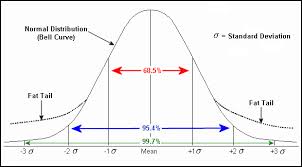
The dreaded “normal” bell curve.

bell curve

The sinister creation that almost ended my career, my professional life.

I’m habitually a big fan of anything curvy, but this one is deadly. A dead man’s curve  – obviously my mental train of thought derailed early on believing in this myth.

I was brainwashed to believe in this curve from the very beginning of my career.

I trusted my teachers.

Why the hell not?

The curve is so logical, clean, warm, comfy, rational, explainable and seductive to us investment types. It’s easy to sell to the masses. It makes brokerage firm compliance departments happy.

The curve provides financial services firms who churn out assembly-line advice, an academic free pass. Empirical justification to ignore the research which followed, proved how the curve was a mathematical convenience, not realism (Mandelbrot & Taleb inspired words of beauty, not mine).

I asked my former employer and others to remind me why we believe in this damn thing.

No answer.

I experienced a flashback: I was back in high school and the popular girls were ignoring me again.

“You get a load of Rosso’s man boobs? And he’s only 15!”

man boobs

Back to the curve:

It’s a mathematical Snuggie of sorts.

It frees hours to sell financial product – Set the money and forget it because stock price movements are random anyway. Don’t stress out. There’s a study out there that proves I can sell you an homogenized portfolio solution and move on. I have sales goals!

The curve provides a sense of accomplishment, finality to a risk management process that has no end. Frankly, during one of the greatest stock market bull cycles in history (which is gone 13 years now), it worked. 

The Gaussian curve when applied to portfolio construction or risk management, underestimates risk. It applies an “everything is gonna be alright,” attitude to every stock market cycle as if every one is a secular (long-term) bull market.

The curve disregards the big moves that wipe you out financially. Huge moves that deviate from the average are well, ignored.

Heck, when you think about it, the curve does describe investors and markets perfectly, right?

Humans are so rational and logical. I guess curves which apply to them should be too?

The curve fooled, “assured me” the failure of Long Term Capital Management was an event that should have occurred every 4,000 years. Unfortunately, I wasn’t reading enough Mandelbrot, Minsky, Taleb or Otar.

No problem. Next disaster I’d be long, long gone.

Easy enough.

Then.

The tech wreck happened.

Still believed. Was told again by my former employer, to believe.

santa

“Yep, I was Natalie Wood. The curve was my Santa gone bad. Bad Santa!”

Then the financial/housing/banking crisis kicked us in the groin five years ago. I think of Hans Moleman from The Simpsons getting his noids smashed by a football.

pota hans moleman

But this time I wasn’t going to be fooled.

No more Hans Moleman. On the ground. In the fetal position.

Nope.

Oh..

Here’s how some of my questioning to those smarter than me at my old firm went in 2007 when sub-prime issues were gnawing at me. I asked the same questions in 2010. Amazingly, I received identical responses.

Both times I asked.

“Can there be another financial crisis say, like the Great Depression?”

I was told:

“The odds are unlikely.”

I would have received a smarter response by shaking my Magic 8 Ball.

And yet. Still.

Why did I believe the bullshit?

Drink the Kool-Aid?

Live and learn. I’m sorry.

The mass assembly-line financial services firms still tout the curve.

And they’re going to seduce you with it again as this cyclical bull market rolls on. Fall for it and it’ll plant your money like a talking human right in the middle of “Ape City.”

brain cut out

“You cut his brain you damn, dirty apes!”

Don’t be a slave to the “normal” bell curve.

Here’s how to avoid the pitfalls.

Random Thoughts:

1). Realize you’re not rational which means markets aren’t either. First, my thought is, as people, we’re one breath away from becoming unglued like the crowds killing each other over $2 waffle irons at Wal-Mart during a black Friday midnight sale.

trampling

Here’s your bell curve: Rational investors on black Friday.

As systems are managed by people and we are emotional beings, panics can and will occur more frequently than a Gaussian Curve indicates. Much more. And how many financial disasters do you need before you’re ruined? Oh you know the answer. JUST ONE.

Per Benoit Mandelbrot (he was a math guru for good, not evil) & Nicholas Taleb, the 1987 stock market crash based on bell-curve finance was something that could hap­pen only once in several “billion billion” years.

If my math is correct, disastrous years 1987, 1998, 2001, 2008 are a hell of a lot shorter in span than a billion billion years apart!

Per the curve and those who preach it, stock markets are estimated to blow up in hmmm, the year 3950?

grape juice plus

Don’t be delusional like Zira overdoing the “Grape Juice Plus,” aka champagne.

2).  Know the facts. Ed Easterling from Crestmont Research is a pro who debunks the validity of the bell curve and its application to stock market gyrations. 

Ed provides return frequencies over 101 rolling ten-year periods. What does it mean and how does it destroy the bell curve theory?

The average return of the 101 periods is 10 percent. However, as Ed states “average rarely happens.” And the curve lives for the average.

Historic returns are “barbell shaped,” not “bell curved.” Plain to see.

ten year returns

If more returns circulated around the average, the blue bar would be more pronounced.

Stock market returns outside of the neat and tidy world the financial industry tried to create, tend to cluster and prices have a “memory” of sorts and gust like wind.

When you step back, it makes sense?

3). Where does your adviser stand? Ask the question. As an adviser, I can’t ignore the damn thing however I’m well versed in its pitfalls. Market price changes are more “messy.” Less bell curvy. Price movements are not as uniform as the curve outlines.

If your adviser believes hook, line and sinker in this curve, you’re going to lose your ass. Time for you to find another professional while times are good.

“Markets keep the memory of past moves, particularly of volatile days, and act according to such memory. Volatility breeds volatility; it comes in clusters and lumps. This is not an impossibly difficult or obscure framework for understanding markets. In fact, it accords better with intuition and observed reality than the bell-curve finance that still dominates the discourse of both academics and many market players.” Mandelbrot, Taleb.

4). Large market swings are NOT anomalies. Financial professionals and they’re clients are told to believe that large market swoons are rare – like as rare as Earth being overrun by smart, talking apes seeking to enslave you.

Listen, nobody can predict when a disaster is going to strike; being open to the fact that it can happen more often than once every 5 billion years is a fine start, however.

How Fractals Can Explain What’s Wrong With Wall Street.

Print the article from Scientific American. Send a copy to your financial partner for discussion.

You may be surprised (or shocked) by what you find.

Perhaps it’s your portfolio’s destiny to beware the curve.

Dr. Zira: What will he find out there, doctor?
Dr. Zaius: His destiny.

zauis

Five Questions to Ask a Financial Adviser. Today. I Mean Right Now.

“He was annoyed with me after awhile. He said I asked too many questions.”

annoyed

It’s tough for me to imagine speaking these words to a client or anyone seeking guidance. I wouldn’t have the guts. Or the hubris.

Or the stupidity.

I wonder about (and I’m thankful) for complacency among some advisers. It allows me to continue to gain thoughtful, inquisitive clients who never feel that I’m annoyed by a passion to learn.

The noblest efforts we undertake as trusted financial partners are to listen, answer questions, validate good behaviors, empower improvement and communicate effectively to our audience.

How does a prospective client – One who has a genuine curiosity in her finances, a successful saver and investor, ask “too many questions?”

If you’ve been with an adviser long enough to feel comfortable together, or maybe you’re exploring a new financial relationship, asking questions should be encouraged.

There’s no such concept as “asking too many questions.” You query enough to satisfy your need for information requested. I’ve noticed how the more self-aware an individual is about their financial situation, the more questions that arise.

There’s no reason to feel intimated or stifled.

You’ve earned the right (and the money).

Be bold.

Frankly, investors are not inquisitive enough.

It’s time to ask the five questions: It would be a mistake not to.

1). What common mistakes should I avoid during my employer benefits enrollment period? Go ahead. Pick an adviser’s brain. Most important is to fully understand the importance of the disability and life insurance options available to you. Insurance is a topic employees tend to overlook. An adviser can help you narrow down how much coverage is required. According to the Social Security Administration, roughly 100 million workers are without disability insurance coverage. Astounding.

2). Should I opt for a high-deductible healthcare plan tied to a Health Savings Account? Depending on the health of your family, your history of seeking medical care, your tax bracket, it’s worth considering a healthcare plan with a higher deductible and to shelter pre-tax dollars into a Health Savings Account. The money set aside in a HSA can be used to pay the high deductible tax free and the remaining balance can accumulate tax-deferred every year (unlike a Flexible Savings Account which is more “use it or lose it.”) In addition, since an HSA is cost effective to administer, your employer most likely will contribute a specific dollar amount to bolster your HSA savings. For 2014, the HSA total contribution limit is $3,300 for individual, $6,550 for family. Tack on an additional $1,000 if you’re 55 or older.

3). Is it a good time to rebalance my portfolio? How? Seek to understand if and how an adviser actually follows a plan to sell high and buy low in a portfolio (which for most investors, is very difficult to do on their own). A strategy to rebalance on a regular basis is crucial to manage portfolio risk. Rebalancing will make you queasy: Selling what’s hot and purchasing what’s cold works against what your gut advises you to do. Begin with your 401(k) or retirement account first since there are no tax implications for trimming winners.

4). How do you incorporate my spouse, life partner and children in your planning for me? You don’t exist in a vacuum. An adviser should maintain a holistic approach to financial planning and that includes communicating with loved ones and teaching children how to be better stewards of money. The meetings, communication must be ongoing. At least annually.

5). What are your interests outside of investing? For me it’s writing, movies, short getaways. An adviser must seek balance to maintain perspective (and health). Additional questions – What kind of movies do you like? How about the books you read? Are you accessible on vacation? can arise. For me, clients are accessible to me when I’m on vacation. It’s a personal standard of service. If your adviser isn’t available, seek to understand who is during vacation time.

Questions are an integral part of any relationship. As a friend recently taught me – not asking them in a timely fashion can create resentment and anger.

nosy You’re not being nosy.

You’re no nag.

You’re seeking information to make an informed decision.

About a topic close to your heart.

Financial well being.

No questions asked.

Life in Tangerine: Five Ways Orange Can Color Your World.

Orange has been a special place for me. Always.

It’s the reflective light of sunset sliding across blue spruce. It’s a color of calm – self-actualization. Colored peace painted in quiet.

My grandmother believed there was this energy connection. I never truly understood until I was much older. She said it was strong enough to forge a heart to the soul. She would lament about this cryptic stuff relentlessly when I was a kid and I’d chalk it up to her old age (40) or her hatred for my grandfather or overcooking the meatballs. I shook my head  a lot. In private. I adored her too much to be disrespectful. I thought she was corny most of the time.

Not anymore.

She was funny/strange that way. Nellie believed the genesis of any positive energy was born in the heart. Passion, love.  It didn’t matter how good your head was. 

If your heart wasn’t in whatever you did, it wasn’t worth shit. I spent much of my life believing in the false energy of ego. A shade of shit. Masked as orange. 

And we all know the color of shit. 

It isn’t orange.

Well it can be orange. Like at Halloween in the early 70s when I felt it was my duty to eat a dozen Entenmann’s Halloween cupcakes every fall. I recall the “by-product” of overconsumption being orange.

entenmanns cupcakes How can you not want to devour 12 of these?

“Grandma, what’s the color of this energy.”

You guessed it.

 orange rose

As a child, happiness danced the color of Princeton orange sparks. And that shade of hope, thank God, hasn’t changed. It disappeared for an extended period. I live with that colorless mark on me. Unfortunate events drain the juice from the orange, quick. It’s never too late for the colors of your life to return.

My ongoing challenge is to continue to experience the orange as a beat-up (and still kicking) adult. And it’s working. The process is slow, but I’ll take it at whatever pace it wants to re-ignite me.

I would dare to say orange has been my pumpkin of joy. All the good things in my life, and I need to count my blessings more often, consistently burst in slices of orange.

Apparently, I’m not the only one who feels this way about pumpkin. Or orange.

Starbucks understands pumpkin power!

How do you focus on expanding the orange vibe of your life?

Some have figured it out.

Orange can color the happiness and warmth of your world, too.

Here’s how.

Random Thoughts:

1). All the best lessons from my teachers and mentors burst orange-red. I have applied their lessons to helping people make better financial decisions. Their written and spoken words have elevated me to be a better money manager, empathize deeper with clients and influential people in my field.

Through continuous guidance from James Altucher I have learned to forgive and choose myself. And every time he reminds me to do so (and he’s there a lot for me) I can smell, feel, touch, the fire of orange.

From Kamal Ravikant my orange glows spiritual. His words are always there, reminding me to live my truth, drop the false seduction of ego, control my efforts every day, create the orange on a daily basis and not to worry about the possible black of an outcome I cannot control. I lived in the dark of outcomes, my failures, for too long.

Srinivas Rao‘s words have encouraged me to form my own instruction manual, color outside rules I’ve created. I’m allowing them to breathe in orange, In the spirit of originality. A mental heat, emblazoned deep in orange flame, has helped me break the rules-based chains others have forged for me to follow.

The path I created, the one I now follow, is emblazoned in orange. The boundaries around those rules are mine to own and if the intentions are true orange, the rules will take me to a new shade of success.

Remember the lessons from your teachers and mentors. Write, highlight them, burn them bright orange into your brain. Thank those teachers for the words as much as you can. Never tire. Never forget. Help them. They need you, too. 

2). The best memories I have of my loved ones are tangerine-toned. What I choose to remember – the good things about my family – lessons they’ve taught through imperfect action, the ability I possess to make the best Italian spaghetti sauce (thanks nana), my dad’s flair for dress. The birth of my only daughter. It’s funny. She loves everything orange too. Perhaps it’s genetic.

Never let go of the best of the ones you love. Ones who are here now, those who are gone. Honor them in orange as much as you can. They’re looking out for you. Spirits are orange.

3). The limited shades of genius formed outside my comfort zone glow amber. And when they work, I can feel the flame ignite another flash of brilliance until each step I take bursts in shards of orange.

Always remember how society will seek to force you to follow their version of you. 

“Here’s to the crazy ones. The misfits. The rebels. The trouble-makers. The round pegs in the square holes. The ones who see things differently…they change things. They push the human race forward. And while some may see them as the crazy ones, we see genius.”

Steve Jobs

4). The ability to make a difference feels like orange to me.  When clients follow my financial advice, when I can help investors overcome an emotional bias, when I know I made an impact to someone’s financial well-being, my faith in orange returns.

Make a difference through your expertise, life experience. We are all experts in something. Even your pain can teach others. How can you share your skills, knowledge in ways that shapes or improves others? Think about it. You already have  touched others positively. Now build on it. 

5). Orange is sweet, it’s got spice. The environment you live, the people in your life can either add to the sweet and spice of you. Or take it away.

Choose carefully. Say no to an environment and people who suck the sweet and spice out of you. James Altucher has helped me understand the power of “no.” After you say “no,” after the first time, it gets easy. You’ll get good at understanding when to use “no.” Repeating no to yourself is just as important. Are you worthy of saying no, drawing the orange line in the sand? 

You are.

And orange will be there.

Orange is autumn.

And autumn reminds us how shedding of the old, transitions us to further growth.

Orange means to live in the present.

Orange is now.

It’s you.

At your best.

At. This. Moment.

orange color

Yep.