The Hump Day No-Spend Day Challenge – 5 Steps to Financial Success.

To be the best with managing your finances; to master what goes on in your head, focus on the present moment.

A money action you take right now is part of a bigger picture.

Success with money comes with the little steps you take daily.

Mid-week is a perfect time to focus.

Yea I know you hate the hump day camel, right?

hump day HA! Fooled ya!

Now that I have your undivided attention, here’s what to do.

Well, before that, there’s this:

Wednesday was powerful for advertising when I was a kid. We were brainwashed by television in New York that Wednesday was “PRINCE SPAGHETTI DAY.”

I still remember the commercials. I drove my mother insane. I would only eat PRINCE SPAGHETTI on Wednesday. It got so bad she fired off a complaint letter to the Prince Pasta Company.

No Pastina, no rigatoni. Spaghetti. Prince Spaghetti. For years.

prince spaghetti day

So let me brainwash you for a month. That’s all.

One month.

Random Thoughts:

Ask yourself these questions then answer honestly. No cheating!

How much will you spend today? What is the focus of your spending? Create the visuals. Make mental notes. Take an inventory. Then ask.

Are the expenditures necessary? Now that you had a chance to think about how your hard-earned money will be spent, step back and consider – which are needs, which are wants.

Can you now wait until the middle of next week? If the purchase is a want, see if you can do without it for a week. A week from today. That’s all I ask!

OK, so what if it’s a need? Still wait if you can. See if you can lower the cost of the purchase. Use the time to do some homework. Shop around.

Can you make every Wednesday a no-spend day? Complete this exercise for two weeks a month.  At the end of the month, discover how much more money you have remaining in your checking account.

See? You have trained your mind to delay gratification!

Greater money discipline comes from a focus on the present moment.

And today.

For me anyway.

Well, you know.

messy spaghetti


Dad Was Seduced By A Cougar: 4 Ways To Avoid Money Temptation.

Admittedly, she was a seductress.

Who could blame him for falling in love?

I still remember how she glistened in the summer sun.

Hot to the touch.

Smoking hot, actually.

I was as enamored as he was.

I was young, yet I remember like it was yesterday: “Her” name was Tammy.

Heck, I named everything “Tammy.” I had a mad crush on my babysitter.

1973Could be Tammy.

However, this “Tammy” was a 1969 Mercury Cougar convertible – a black-glazed exterior elegance with cool white leather underneath a rag top.

Great lines and tough to ignore.

cougar exterior

Years later, I learned the source of the money to purchase the sporty model was set aside by my mother’s hard-working father who came from Italy and lived in two rooms above a Mulberry Street, New York grocer – also his employer.

I can’t imagine how long it took papa to save $4,000. I’m sure his entire life –a respectable nest egg on his measly wages. I still admire his strong saving discipline.

Before he died, Giuseppe Zappello instructed his daughter: “This money I leave behind is to be used for Richard’s college education only.” He wrote his last instructions on crumpled note paper and gave it to mom shortly before his death from pancreatic cancer.

For Grandpa Joe, it was important that I further my education; it was his only request. I know he wasn’t enamored with my father and felt it important to outline how he wanted the money utilized.

Shortly after his death she decided to hand over the money for the purchase of an automobile, taking an action grandpa would have hated.

I’m being kind here.

I believe mom probably caused Papa Joe to roll over in his grave.

For years, it bothered me she made this decision; it was troublesome that dad was short-sighted, too. I can’t imagine blowing my daughter’s education fund on a car.

Bad money decisions tied to financial infidelity are not new. Family members can be affected by them for generations; money mindsets forever forged by them.

A recent survey conducted by the National Endowment for Financial Education (NEFE) was conducted online among 2,035 adults 18 and older. The topic: Financial infidelity between partners. It was released on Valentine’s Day. Perfect.

From the results:

“According to the new survey, one in three couples who combine their finances admit to lying to their partner about money. The survey also finds that 76 percent of financial deceptions have an effect on the relationship.

The survey finds that three in 10 have hidden either a purchase, bank account, statement, bill, or cash from their partner or spouse. And 13 percent said they have committed more severe deceptions, like lying about the amount of debt that they owe or even the amount of income that they earn.”

I’ve been bad about following rules, especially when it comes to sharing my financial decisions with others. To be clear: I will share information however, I’m going to move forward on my intentions as long as no one is hurt financially, or others may prosper.

I admit – my money “imprint” is based on mom’s willingness to turn over my college fund to dad just so he can purchase a depreciating asset.

I ask:

Why is the definition of financial infidelity so narrow? Why can’t it occur between a parent and a child, friends, an individual’s actions vs. original intentions? Mom failed to follow through on grandpa’s last request.

She gave away blood money for a want, not a need which makes it more painful for me to understand.

She wasn’t strong enough to say “no” to my father.

just say no

Although, I believe a  measured dose of financial infidelity can be healthy.

For example, what if mom never told dad about the money earmarked for me? I figured the $4,000 she gave willingly could have been conservatively worth $8,000 by the time I needed it for college. Not a fortune, but it would have helped.

What can you do to avoid money temptation and financial infidelity?

Random Thoughts:

1). Broaden, outline and then communicate your definition of financial infidelity. Before marriage, make sure you communicate (write out and share) with your future partner specific actions you would classify as money cheating. I met with a couple recently where the man thought it was money infidelity for his fiancé to pay more than $10 for lunch without communicating with him first. In this case, the couple decided not to wed.

Consider broadening your definition to include those you care about including children. For example, I have clearly explained to my daughter how her college funds are for her, nobody else. Her mom is in agreement with this, too. If your definitions conflict or financial rules established are too restrictive at least it’s all out in the open for discussion.

2). Keep separate.  It’s important that separate property remain separate property. Assets held in trust should remain separate per the instructions of the grantor. Document each asset you plan to maintain apart from a future spouse. Communicate your intentions but don’t cross boundaries. These assets are yours. Don’t be talked into sharing.

Money earned before marriage should be maintained separately. If single, direct all your earnings into an individual account since wages, salaries and self-employment income will be considered community property in Texas (and other states) once you’re married. At that point, you should halt transfers of money into the account and maintain it as separate property going forward.

Inheritances need to be separate. It’s in your control to share. Or not. Your choice. Consider carefully whether or not sharing an asset with a spouse or future partner was truly the intention of the provider. In other words, think twice. Then think again. If you do decide to share, document the specific assets in question and sign along with the other receiving party.

Segment the cash you require to make daily purchases like lunches, nights out with friends, and clothes. I know a married couple who have agreed-upon “allowances” they direct automatically to separate accounts monthly from their joint account to cover personal expenses.

If additional money is required, they communicate and then jointly approve or disapprove the requests. I found this method effective for record keeping and accountability. It’s also useful to early detect wayward spending patterns.

3). Keep together. Property purchased during the marriage may be held in joint ownership. A bank, investment account, real estate held jointly is common and advisable if you intend to leave the asset to a spouse upon death. Depending on the size of your joint estate ($5 million or more), it’s advisable to seek an estate planning attorney to create trusts that will preserve estate-tax exemptions and outline your intentions for beneficiary distributions years past your death.

4). Keep away.  If you establish a custodial account for your child keep in mind that the money placed into it is considered an irrevocable gift. In other words, at age 21, the custodian (you) must turn over the asset to the former minor regardless of how uncertain you are of your child’s maturity level at the time of the transfer.

Custodial accounts are easy to establish which is a reason why they’re appealing. However, once money is deposited, it’s no longer yours. There have been cases where former minors have sued parents when custodial assets haven’t been turned over in a timely basis or were not notified of the accounts.

The lesson here is that assets earmarked for children and other loved ones should be considered solely for their current or future benefit. Keep your discipline. Strong mental boundaries should be maintained.

Make sure your intentions to keep away are clear to others.

And perhaps you’ll avoid being seduced by Cougars or other large purchases that drive across your path.

Classic cars are not cheap.

The Premarital Lovin’ Laws – Consider the Money Strings Before the Rings.

There are many challenges to consider when it comes to taking a big step like marriage; conflicting money philosophies can wreak havoc on a relationship.

bad marriage

You don’t need be money twins about financial matters, just hold similar core values. If the relationship with money varies dramatically from your beau’s, you can rest assured conflict will eventually tarnish the bliss.

You may scoff at these overtures; some may appear radical. However, before the rings, discuss the strings. Money strings are the beginning of good or bad threads you’re going to bring to a marriage tapestry.

Here are a few money smart steps to consider:

1). In Lieu of a Wedding Throw a Debt-Relief Gathering – How romantic to slay one of the financial beasts of a successful long-term commitment. Forgo a wedding reception – throw a party for a quarter of the expense. On average U.S. couples spend more than $25,000 on a wedding. If you’re saddled with revolving debt like auto loans and credit cards, then it may be best to use gifts to pay them off or pay down debt dramatically. Throw a nifty party and focus monetary gifts on debt.

Create a written promise to each other that out-of-control debt monsters shall never arise from the dead.

debt monster

2). Create a Personalized Series of Make-or-Break Rules – If you’re serious, well then either the matrimony activities continue, are postponed or cease entirely based on jointly-held money rules.

Be specific when you create them. Here are examples:

If our individual credit scores are less than 700 (based on Fair Isaacs) then marriage needs to be postponed until scores are at least at or above the national average of 723. Marginal credit scores can mean more interest paid on loans including mortgage alternatives. Examine and follow steps to increase your scores on www.myfico.com and re-visit this commitment in six months.

I shall provide proof of my good money habits before the marriage commitment is made. Get ready for money vulnerability – break out your budget history, open the Quicken, outwardly show that you’re taking health care insurance and disability coverage at work. Divulge your liabilities (of the financial kind). Too much debt, lack of insurance and absence of discipline may encourage you to reconsider a marriage at this time.

If individual monthly debts are greater than 25% of our gross monthly incomes, then marriage needs to be postponed until debts fall below set thresholds. I know. I’m taking all the heart out of this, and that’s exactly the point.

As a famous Godfather once lamented: “It’s nothing personal, it’s just business.”

godfather

3). Write out your Personal Money Philosophy and Share it with your Future Partner – If you’ve never formally considered a money philosophy it’s an opportune time to think it through. And you do have one; your money DNA has been with you since youth. It was formed by your parents, friends, and other outside influences. Share the details of this exercise with your partner, yet work on this project alone.

The end result is a couple of sentences that spell out sincere reflection about your ongoing relationship with money.

Here are a few shared with me:

I’ve been afraid of debt for a long time and feel compelled to pay off debts quickly. My parents taught me to not dig a hole I can’t climb out of and I’ve always been that way.”

“I always make sure to have money in an emergency fund.?

“I try to save at least 5% of my salary in my 401K.”

These statements don’t need to be pretty, they need to be real and reflect values about finances.

Consider fun yet money awareness exercises with your financial partners like the card “game” available at www.moneyhabitudes.com. What an eye-opener when it comes to disclosing and understanding couples’ money personalities.

4). Consider Money Vows at the Wedding – Really want to shake things up? How about a money promise as a tie that binds? I’m not kidding! Here are examples from couples who incorporated money messages in their vows:

“I promise to never make a big purchase without you.”

“I promise to never hide a financial mistake from you.”

“I hope for mutual respect and open communication if money issues arise in our marriage.”

death wise

Well, you get the point.

It all seems romantic to me, but then I’m a money guy.

What rules and tips can you create today around  a successful money and marriage partnership?

The Deputy Comes Full Tolle: 4 Ways to Step Back to the Present.

“We let go of all if it & nobody dies.”

Let’s face it.rick grimes four

Rick Grimes has come to know his truth, especially as of late.

Slammed into what is. Punched out of what was.

Confronting rage in attack mode from within and outside fences will shower demons all around you. The confrontation will startle you into where you must be right now. It’s a trigger of sorts. A switch in your head that the primal core of survival, clicks on.

You choose to fight. Stand up for what you believe.

Or.

You fall apart.

Go insane.

Full steam down the road to nothing. The path with no light and a dead end. The gate closes. Locks on you. You can hear it. You shouldn’t travel this place, but it’s too late. The snap in your head is just too loud to resist.

You’re.

Steadfast. Blinders on.

Nothing left.

Die alive.

An alkaline spray fills your mouth, your throat surrenders.

Now you’re chewing on rust.

Liking the taste.

Before who you are drains.

Into blackness.

If you fail to accept the present and fall to the prison of the past, you’re doomed to make the same mistakes.

“Not after Woodbury. Not after Andrea.”

And Philip Blake fades to black.

Forever.

governor gun He was too far gone.

From the inner core of what made him human, humane, the former Georgia lawman had fallen in and out of inhumanity.

An old man believed perhaps a deputy was too far gone.

Until.

The stagger. A right foot. A step back. There it was. Did you see it in the mid-season finale? The empathetic-driven acting of Andrew Lincoln. 

To step back from the fence. I’m sure many didn’t notice. It was just a subtle move. A motion.

But it was important.

It motivated me enough to write this blog post.

It was raw acceptance of what is. Full engagement in the present.

Because we’ve all stepped back when an outside element so threatening shakes us. Erupts from a place inside so deep you can’t describe it.

change

It was a jolt, the shock of the blade. Ready to steal another from his inner circle. From a place behind the heart. Deep.

The moment Rick Grimes knew what he needed to do, to say. The moment he stepped back to push forward into the present. A re-focus on actions, not the outcome. A focus on what he was meant to do, to be.

governor sword

The deputy had indeed arrived (again).

“We all…can change.”

And it caused an old man to smile…

The thought of sacrifice rolled over the aged, former farmer.

Herschel knew. His work was done. And not wasted.

Rick understood the power of what was going down.

He’s shed blood. Lots of it: Those he cherished have bled. Young and old.

Too many times.

He’s mercifully released the living from walking death; others, he let them wander – a rotting stagger penance in-between life and eternity.

dead girl

“Everyone who’s alive right now.. Everyone who’s made it this far..

We’ve all done the worst kinds of things.

Just to stay alive.”

rick grimes five

The former deputy has been there – rotted in the mind.

Memories that linger and rattle like diseased bone. The past gripped Rick’s brain. Poisoned icy tentacles – the old bloodlines have long shriveled. He won’t let them die.

They walk through his head.

I understand.

You do it, too.

zombie lori

Rick allows the past to possess him; it controls his thoughts, guides his actions.

Until the moment.

The devil arrived – forced a response.

When all he’s counted on – the fences, defenses, were suddenly close to annihilation.

the gov kill them all Kill them all!

Everything you care about is in jeopardy.

There’s imminent danger of losing everything, including yourself.

It’s at that point, you change.

Live or you die.

Or die and you live.

Grasp for the black or the light.

It’s time to choose.

Think..

rick grimes two

What will you focus on right now to stay alive?

What stimulus initiates a bold action?

Anger from the past. Anxiety over what’s ahead.

“But we can still come back.”

How does one die to live again? To come back?

The Deputy decides.

“We get to come back… I know.”

Random Thoughts:

1). What will force you into the present? For me: Step back, then a tumble. A corporation I dedicated 14 years of time and blood turned on me, worked me out. The loss of a close friend. Financial distress, physical challenges, choked me into the present.

I gasped for air.

I felt myself go under. I went below surface.

Inside a mental steel trap I never thought I would be.

I found myself eating, sleeping, breathing less.

Saddled with nightmares for the hour a night I did manage to sleep.

For more than a couple of months in 2013, I died.I was walking but I was gone. I contemplated an exit to complete the circle. Thought it would bring relief.

I sought escape. Isolation.

I reached out to teachers: The Altuchers, a Ravikant. God, Buddha, John R. Cash.

rick grimes three

I wanted out of my skin. My diseased brain.

I was exhausting every resource fighting and resisting what was happening to me.

All the resistance caused further damage.

And.

Just as I was about to give up. 

A force out of nowhere slayed my demon.

governor death

A sharp sword of words pierced me.

“If you think about it, how much time do we spend in our heads wishing things were another way, beating ourselves up, beating others up, crafting a different past, wishing for a different future? All of this resistance. All of this pain.”

Kamal Ravikant.

As I feel the warmth and light on my face in 2014, I know the roads traveled to get to the present were indeed for the best. I don’t seek to look back at what’s caused me to begin to live again.

For you? The step back into the present will come from a pain so strong it will feel like your soul has been scorched. Whatever that is for you, you’ll know.

Keep an open mind, it may arrive out of nowhere.

Like a tank at a prison.

What a blessing it will turn out to be.

Although at first it will appear a curse.

dont look back Carl, don’t look back!

2). What actions will you focus on right now to stay alive? The present is all you have. The rest is ego. Vapor. Heavy mist that burns away. Are there words you can share that have the potential to alter someone’s path, make a positive impact, create laughter? What small action can you take after reading this, to choose yourself? Can you do it every day? How can you shed ego to face and release who you are? How much pain will it take to wake up? Everybody’s thresholds are different.

3). Do you fight or relent? Can you accomplish both? Try not to fight the change, it’s gonna happen anyway. Your ego will do anything and everything to hold on. Even if it means killing you to do it.  All the fight. The wear and tear. Just decide now to let it go. Make the decision. You’re facing the enemy today: It’s you. From that point, you can step back and then move on. Otherwise you’ll be stuck for a lifetime in blackness.

4). Be present in your financial footsteps. Every financial action you take now generates a ripple effect throughout your entire household balance sheet. The path of light when it comes to money is to control what you can – avoid ongoing credit card balances, don’t miss out on a company retirement plan match on contributions (this happens often), don’t compare (and beat) yourself to others who may appear to be in better financial shape than you are.

Friends (strangers) like to remind you how they have better stuff, more money saved, great investments that return more than the market.

Be skeptical.

Human nature motivates us to value something more simply because we own it. It’s called the endowment effect.

We’re also fraught with overconfidence when it comes to interpreting the returns on our investments.

To be truly aware, understand that people “embellish” to impress. It’s never too late to begin good financial habits. Comparisons to others will deter and frustrate. You’ll be stuck in an ego-driven, negative financial mindset.

You’re not too far gone.

No matter how old you are. 

And no matter how little you think you are.

Never underestimate your true bold nature.

To survive.

And prosper.

kids

What lessons learned – out of love from others – will come in handy right now?

To get your head straight.

“If you get the inside right, the outside will fall into place. As soon as you honor the present moment, unhappiness and struggle dissolve, and life begins to flow with joy and ease. When you act out the present-moment awareness, whatever you do becomes imbued with a sense of quality, care, and love – even the most simple action.”

Eckhart Tolle

And a loved one, perhaps an old soul.

Smiles just for you…

Somewhere.

herschel smile

Year-End Financial Planning Tips. And a Life Lesson.

Another year.

Gone.  

2013 is history.

Well, almost.

I’m glad.

For me, it is a year to forget. Too much physical, financial and mental anguish.

But their were (are) lessons.

Always. Lessons.

A friend I lost this year asked me – “Must everything be a lesson?”

Well, duh.

lesson

Now I understand why she’s a former.

Let’s wrap up 2013 (good riddance) on a solid financial note.

Here’s how.

Random Thoughts:

1). No need to rush – Among your employer benefits choices, there’s an account you direct money into each pay check. It’s called a “Flexible Spending Account” or FSA for short.  It’s a good thing because it allows you to pay for qualified medical expenses using pre-taxed dollars.  At the end of the year, many of us are in a mad scramble to spend the remaining proceeds in an FSA because it’s been a “use it or lose it” situation. In other words, if you didn’t spend the money before the end of the year, you lost it. Not anymore.  In October the U.S. Treasury Department relaxed the rules. Employers now are able to allow participants to carry over up to $500 in unused funds into the following year.

2). Are you charitable? – The qualified charitable distribution expires at the end of 2013. If you’re at the age where you’re taking required minimum distributions from your retirement accounts, you can still receive a deduction for donations you make directly to qualified charities. Consult a qualified tax adviser to take care of this one. Depending on your household income, you may benefit greatly from implementing this strategy.

3). Clean up. Now is the time to get financially organized.  Consider shredding all financial and tax documents greater than ten years old. The rest of your documents should be organized and placed in binders with tabs.  Make sure to communicate the location of important documents to those who help you make financial decisions or those who would be there if you become temporarily disabled.

4). Rebalance your portfolio. Have you ignored your 401(k) investments? Are you cash heavy? Many investors are.  Meet with an independent financial advisor for a written plan customized for you. Speak to a representative of your employer-provided plan about something called “auto-rebalancing” where investments are bought (low) and sold (high) at least on an annual basis. Work to increase retirement savings by 1% from the first pay you earn in 2014.

5). Review your holiday spending.  At the end of each year, I do a brutal self-assessment to determine how and why I perhaps went over budget and compare my spending to the previous year. For some, this is a wake-up call as you become accountable to yourself for overspending.

It appears American consumers have become smarter about taking on debt during the holidays based on a recent survey by the Certified Financial Planner Board of Standards.

New Survey Reveals American Holiday Traditions: Financially Smart Gifting and Receiving.

6). Write your two-year plan.  AJ Leon, an inspirational character who classifies himself as a “misfit” has figured out how to get the most out of life. His essays in a body of work titled The Life and Times of a Remarkable Misfit, are inspirational and more. If you seek to change your perspective, the free download is a must read.

AJ asks you to become accountable to yourself, your dreams. Write at least 500 words about where you want to be in two years. Once complete, send that gut-wrenching piece of work in an e-mail to someone who will hold you accountable. Now your aspirations are out there. Exposed.

You’re committed.

There’s no going back.

And 2014.

Will be it.

Yours.

The year you waited for your entire life.

brass ring

Go for it.

Command Your Own Drones to Financial Success.

What public relations genius!

Jeff Bezos, the CEO of Amazon, made huge media headlines by suggesting the future of light package delivery may be completed by drones as opposed to the normal, albeit boring methods of delivery we all know now.

amazon drone Um hi!

I wondered.

What the heck is a drone?

funny drone

I know – seems obvious. But is it?

An unmanned aerial vehicle:  The flight is controlled either by computer or remote control of a pilot from a remote location.  Some can fly as high as 50 thousand feet and go supersonic.

Wow.

Got me thinking…

Financial success is automated activity from 50,000 feet above your wallet. Cutting out that extra latte is not going to make you wealthy; placing as many good money habits as possible on auto-pilot is the key to financial stability.

Here are some ideas on how to command your own financial drones to success:

1). Budget on auto-pilot.  When you budget on a daily basis it’s tough to feel the positive. It feels like dieting. Or dating. Or root canal. Keeping track of expenses manually is admirable. However, it’s inevitable you’ll give up because you’re human. You have a busy life. Even if you’re proficient at manual tracking, you won’t be able to effectively interpret your long-term spending habits. Analyzing longer-term spending trends (at a higher altitude) will expose where you need to make real improvement.

Budgeting is boring; many won’t continue for long. Take your analysis to a higher level and place on auto-pilot through www.mint.com. Mint allows you to accomplish three things: See where your money goes, make budgets to stay on track, and set financial goals for the future. Mint connects to your bank accounts and updates automatically. It’s free and safe as Mint utilizes bank-level encrypted security.

Easy-to-read graphs allow you to track spending, income, net worth and account balances over time.  After a couple of months of activity, sit with an objective financial partner. Together, create a game plan to cut the expenses that will make an impact to your bottom line.

Go ahead. Enjoy your fancy coffee. For now.  Mint will track your addiction!

2). Pay yourself first.

Don’t roll your eyes.

eye roll

You’ve heard this one before, right?

The best financial rule (and I’m critical of most financial rules of thumb) is easy to follow and from a higher altitude, or the long-term, will result in a substantial positive impact to your bottom line. Before expenses are paid, before you treat yourself to a movie, it’s important to save money for emergencies and for your future – FIRST.

How?

3). Set savings on auto-flight:  Pay yourself by initiating instructions to move three percent or more into a company retirement account every pay period.  Ask your HR department how to accomplish this simple task. Do the same by establishing instructions to automatically transfer a specific dollar amount, say $25 bucks a month from your checking account into savings.

4). Go stealth on a savings target: Every three months, increase the dollars directed from checking to savings by $10. Select an amount that works for you.  Think under-the radar increases.  Barely noticeable; yet over years, this tiny habit will result in big change (and dollars). You will look forward to saving money because you’ll realize how painless it is!

Forget buying more stuff you don’t need by drone delivery.

Now’s the time to establish your own small army of financial drones.

And fly your own path to financial success.

dont drone me

Reversion to the Mean is a Bitch – 3 Ways to Avoid Getting Killed When The Next Market Pullback Occurs.

Dear friend and teacher Lance Roberts’ writings get my attention.

Admittedly, his work feeds my confirmation bias as we tend to agree on most topics, especially when it comes to stock market valuations, the macro-economic climate, reversion of averages and most important – the mistake of benchmarking a portfolio to a market index like the S&P 500 or as I call it:

“My brain and ego are both bigger and smarter than the market as a whole.” 

dumbass

Investment managers who claim to consistently beat the market also will boast how they’re above-average drivers, lovers, parents.

Bull.

Avoid them.

It’s this kind of performance-based thinking (or lack of it) that seduces investors to take portfolio actions based primarily on greed. Or fear. Most investors generate above-average returns, didn’t you know?

Until the math is done to prove how well below-average their returns are.

Some compare their lousy returns to a friend’s (embellished) performance and grow frustrated enough to place their risk tolerance aside and create portfolios which are too aggressive for their nature. At the first sign of market pull back I’ve watched these investors sell everything and ostensibly suffer unnecessary losses.

As people we are bigger than life in our own heads.

big head

It’s that kind of myopic ego-based bullshit that can take over the mind of a money manager who then takes on more risk at the wrong time. And if your money manager is getting increasingly aggressive NOW, then this is the WRONG TIME.

And it’s with your money.

Lance’s recent piece 30% Up Years: The Case For “Cashing In” resonates with me.

The writing doesn’t need explanation – it’s perfect as is. It requires an awareness. The messages shouldn’t be minimized even though we are in a favorable market environment which is based in part on seasonal factors along with money managers’ desire to play “catch up” on returns as they close out the year.

In other words, we have moved beyond fundamentals into momentum territory. Just be aware!

caution

It’s ok to participate if you understand what’s driving stock returns. If you believe it’s primarily fundamentals, you should stay out now. Stick with short or ultra-short term bonds and go live your life. Be happy.

Don’t fool yourself.

At this later stage of a cyclical bull market, self-denial, hubris and financial industry media will get you in trouble.

Investors and their financial partners must remain vigilant of risks of markets drunk on unprecedented Federal Reserve policies and publicly-traded corporations who continue to book record profit margins by treating employees like indentured servants.

In case you’ve been under a rock: Corporations survive solely to placate shareholders and buy back shares.

Employees and customers have limited influence on senior management. It’s worse since the financial crisis.

As former U.S. Secretary of Labor Robert Reich lamented recently through social media:

A few decades ago, when American companies were still American and when corporate profits still bore some relationship to the wages of most Americans, the nation fretted over the “competitiveness” of U.S. corporations. But now that the stock market has gone through the roof while most Americans are in the cellar, that old worry seems a bit quaint. For example, Walmart, America’s largest employer, …is highly competitive internationally. Yet it claims it can’t afford to pay its U.S. workers more than the miniscule wages it doles out to them. The claim is dubious. According to data compiled by Bloomberg, Walmart has bought back about $36 billion of its stock over the past four years, and in June announced another $15 billion of stock repurchases. The effect is to bolster the value of the remaining shares of stock.

Corporations will overwork labor and continue to perpetuate wholesome corporate philosophies driven underneath by limited vision, anemic research and development, and an ongoing fear that’s pumped into the brains and hearts of their employees.

The message by middle management remains pervasive: “Be thankful you have a job,” is still heard in meetings (I’ve asked. I know). The words are considered “motivation.”

Unfortunately, many workers are too frightened to leave or are saddled with too much household debt so they continue to languish in their soul-sucking corporate positions.

Perhaps your employer is different.

cubicle death

Uh-huh.

Hey, as a money manager, I love it!

It’s one of the reasons, even though I’m cautious, that markets can continue to do well through the end of the year and first quarter of next. 

At this mature stage of a cyclical bull market, it’s important to avoid allowing your hubris to go haywire. Don’t believe you’re just so damn good, your next goal should be to “beat an index.”

Here are Lance’s rules as to why it’s impossible (along with my commentary); I’ll add three ways to let keep yourself in check as markets eventually revert to a mean:

“While Wall Street wants you to compare your portfolio to the ‘index’ so that you will continue to keep money in motion, which creates fees for Wall Street, the reality is that you can NEVER beat a ‘benchmark index’ over a long period. This is due to the following reasons:

1) The index contains no cash. And you should always have cash. Cash is an asset class, cash is for withdrawals, cash is the ultimate diversification, cash is there to make attractive purchases.

2) It has no life expectancy requirements – but you do. Stocks for the long term? Can you wait 30 years to break even when you purchase at lofty valuations? NO.

3) It does not have to compensate for distributions to meet living requirements – but you do. You also should maintain two years worth of distributions aside for living expenses in retirement.

4) It requires you to take on excess risk (potential for loss) in order to obtain equivalent performance – this is fine on the way up, but not on the way down. Losses are tougher to make up. If you lose 50% you’ll need 100% to get back to even.

5) It has no taxes, costs or other expenses associated with it – but you do. If you invest you’re gonna have fees, commissions. There is no free lunch when it comes to expenses.

6) It has the ability to substitute at no penalty – but you don’t. Commissions, taxes will drag on returns.

7) It benefits from share buybacks – but you don’t. On occasion you benefit from a stock that now has better EPS due to buybacks, however, there’s no consistency to this for you.

In order to win the long term investing game, your portfolio should be built around the things that matter most and beating an index isn’t one of them. It’s great for cocktail party conversation around holiday season, but that’s about it. 

Here’s what’s important. Never forget:

* Capital preservation (A lost opportunity is more easily replaced than lost capital).

* A rate of return sufficient to keep pace with the rate of inflation.

* Expectations based on realistic objectives. (The market does not compound at 8%, 6% or 4%. Losses destroy the effects of compounding returns). 

* Higher rates of return require an exponential increase in the underlying risk profile. This tends not to work out well.

* You can replace lost capital – but you can’t replace lost time. Time is a precious commodity that you cannot afford to waste.

* Portfolios are time-frame specific. If you have 5-years to retirement, but build a portfolio with a 20-year time horizon (taking on more risk), the results will likely be disastrous.

Three ways to avoid losing your ass, right now:

1). If you must commit capital to stocks 5 years after the financial crisis, go SMALL. Let’s face it: You missed the big ship. Go for the dinghy and be happy. Keep your stock allocations below 50%. Keep the rest in short term fixed income or yes, cash.

2). Work with an advisor who will calculate your required return. To meet a personal benchmark. THEN WORK BACKWARDS into the asset allocation plan. Most financial consultants are there to sell you product, not to calculate your desired return. And remember generating return takes work on your part, too – Increased savings, lower debt-to-income household ratios. working longer. There’s no sexy magic here. If you’re being sold an investment first: WALK. 

3). Now is the time to stop listening to friends and family about stocks. The extremes in sentiments will confuse you. Aunt Millie sold out in 2009 and won’t go back. She’s awaiting the “big one,” the crash.  Joe went “all in” two years ago and is up a billion percent. There’s a happy medium. Cut the noise. Create rules, work the numbers. Understand where you are behaviorally when it comes to risk. Does your adviser assess you behaviorally or utilize some bullshit risk tolerance questionnaire which tells you nothing about yourself.

Pay the 40 bucks, take the test and bring the results to your advisor. Most likely, you’ll need to do this before you sit with a financial pro.

Finametrica.

As Lance writes so perfectly: “The index is a mythical creature, like the Unicorn, and chasing it takes your focus off of what is most important – your money and your specific goals. Investing is not a competition and, as history shows, there are horrid consequences for treating it as such.”

Be thankful for good advice this year.

Know your limitations.

Accept who you are from a risk perspective.

Work with an objective financial partner who listens to you.

And get your ego out of your portfolio.

ego

When the Financial Industry goes Ape: Escape from the Planet of the Bell Curve.

I was (am) a huge fan of the iconic Planet of the Apes movie franchise.

The original films: Not the attempts at remakes.

Shameful.

POTA blew to hell 

You blew it all to hell – I blame financial services.”

Every six months, in the early 70s, there was a Sat­urday “Go Ape” marathon at the Brooklyn neighborhood movie theatre (the Mayfair), which provided parents a rare opportunity to unload the kids for an early morning into late afternoon.

God knows how many children were conceived during an Ape-A-Thon weekend.  We would sit all day (or try) and watch all five POTA movies in the original order they were released to theatres – Beyond the apes, revenge of the apes, beneath the apes. Ushers dressed as apes. It was magical.

The Sunday after Ape Day was a time of rest and repulsion for anything hairy (I didn’t even want to pet the dog).

Confusion set in for me after the third installment of the simian series (Escape from the Planet of the Apes). To this day, I’m still puzzled.

Movies with any hint of time travel remain a frustration.

After watching (and taking notes like an asshole) the film “Inception” six times I still don’t understand what the hell happened at the end. My mind, the ability to think, falls into a black hole if I’m required to follow a story line through space, time, dreams.

I work to follow the sequence but I tune out in a huff.

Lord forgive me. I’m just not that smart.

Let me try this again. 

The ape planet turned out to be Earth (shocker!). Got it. Andddd the astronaut (Taylor, played by Charlton Heston) who landed on said ape planet eventually blows it (Earth) literally to pieces by triggering a massive nuke. Worked through that ok. After that? It’s a time forward/backward hot mess.

The first talking ape (Ceasar) born on Earth alters the course of history in 1991, I think. Planet of the Apes begins! Ceasar’s mom Zira after getting loaded up on too much “grape juice plus” aka champagne slurs out that Earth blows up in the year hmmm 3950. That’s how she says it: “Hmmm, 3950.” Like a drunk monkey. 

POTA Grapefruit plus

Zira tipsy on “Grape Juice Plus.”

SO the parents of the ape who began a simian revolution in 1991 saw Earth blow up in 3950 and the astronaut who landed there in 1970 was responsible. You see where I’m going with this? I should think it through but I’m just not patient or perhaps, smart enough. Frankly, I don’t desire to be this clever.

Confusing yes, yet still more logical than the financial industry’s holiest grail:

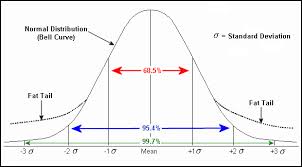
The dreaded “normal” bell curve.

bell curve

The sinister creation that almost ended my career, my professional life.

I’m habitually a big fan of anything curvy, but this one is deadly. A dead man’s curve  – obviously my mental train of thought derailed early on believing in this myth.

I was brainwashed to believe in this curve from the very beginning of my career.

I trusted my teachers.

Why the hell not?

The curve is so logical, clean, warm, comfy, rational, explainable and seductive to us investment types. It’s easy to sell to the masses. It makes brokerage firm compliance departments happy.

The curve provides financial services firms who churn out assembly-line advice, an academic free pass. Empirical justification to ignore the research which followed, proved how the curve was a mathematical convenience, not realism (Mandelbrot & Taleb inspired words of beauty, not mine).

I asked my former employer and others to remind me why we believe in this damn thing.

No answer.

I experienced a flashback: I was back in high school and the popular girls were ignoring me again.

“You get a load of Rosso’s man boobs? And he’s only 15!”

man boobs

Back to the curve:

It’s a mathematical Snuggie of sorts.

It frees hours to sell financial product – Set the money and forget it because stock price movements are random anyway. Don’t stress out. There’s a study out there that proves I can sell you an homogenized portfolio solution and move on. I have sales goals!

The curve provides a sense of accomplishment, finality to a risk management process that has no end. Frankly, during one of the greatest stock market bull cycles in history (which is gone 13 years now), it worked. 

The Gaussian curve when applied to portfolio construction or risk management, underestimates risk. It applies an “everything is gonna be alright,” attitude to every stock market cycle as if every one is a secular (long-term) bull market.

The curve disregards the big moves that wipe you out financially. Huge moves that deviate from the average are well, ignored.

Heck, when you think about it, the curve does describe investors and markets perfectly, right?

Humans are so rational and logical. I guess curves which apply to them should be too?

The curve fooled, “assured me” the failure of Long Term Capital Management was an event that should have occurred every 4,000 years. Unfortunately, I wasn’t reading enough Mandelbrot, Minsky, Taleb or Otar.

No problem. Next disaster I’d be long, long gone.

Easy enough.

Then.

The tech wreck happened.

Still believed. Was told again by my former employer, to believe.

santa

“Yep, I was Natalie Wood. The curve was my Santa gone bad. Bad Santa!”

Then the financial/housing/banking crisis kicked us in the groin five years ago. I think of Hans Moleman from The Simpsons getting his noids smashed by a football.

pota hans moleman

But this time I wasn’t going to be fooled.

No more Hans Moleman. On the ground. In the fetal position.

Nope.

Oh..

Here’s how some of my questioning to those smarter than me at my old firm went in 2007 when sub-prime issues were gnawing at me. I asked the same questions in 2010. Amazingly, I received identical responses.

Both times I asked.

“Can there be another financial crisis say, like the Great Depression?”

I was told:

“The odds are unlikely.”

I would have received a smarter response by shaking my Magic 8 Ball.

And yet. Still.

Why did I believe the bullshit?

Drink the Kool-Aid?

Live and learn. I’m sorry.

The mass assembly-line financial services firms still tout the curve.

And they’re going to seduce you with it again as this cyclical bull market rolls on. Fall for it and it’ll plant your money like a talking human right in the middle of “Ape City.”

brain cut out

“You cut his brain you damn, dirty apes!”

Don’t be a slave to the “normal” bell curve.

Here’s how to avoid the pitfalls.

Random Thoughts:

1). Realize you’re not rational which means markets aren’t either. First, my thought is, as people, we’re one breath away from becoming unglued like the crowds killing each other over $2 waffle irons at Wal-Mart during a black Friday midnight sale.

trampling

Here’s your bell curve: Rational investors on black Friday.

As systems are managed by people and we are emotional beings, panics can and will occur more frequently than a Gaussian Curve indicates. Much more. And how many financial disasters do you need before you’re ruined? Oh you know the answer. JUST ONE.

Per Benoit Mandelbrot (he was a math guru for good, not evil) & Nicholas Taleb, the 1987 stock market crash based on bell-curve finance was something that could hap­pen only once in several “billion billion” years.

If my math is correct, disastrous years 1987, 1998, 2001, 2008 are a hell of a lot shorter in span than a billion billion years apart!

Per the curve and those who preach it, stock markets are estimated to blow up in hmmm, the year 3950?

grape juice plus

Don’t be delusional like Zira overdoing the “Grape Juice Plus,” aka champagne.

2).  Know the facts. Ed Easterling from Crestmont Research is a pro who debunks the validity of the bell curve and its application to stock market gyrations. 

Ed provides return frequencies over 101 rolling ten-year periods. What does it mean and how does it destroy the bell curve theory?

The average return of the 101 periods is 10 percent. However, as Ed states “average rarely happens.” And the curve lives for the average.

Historic returns are “barbell shaped,” not “bell curved.” Plain to see.

ten year returns

If more returns circulated around the average, the blue bar would be more pronounced.

Stock market returns outside of the neat and tidy world the financial industry tried to create, tend to cluster and prices have a “memory” of sorts and gust like wind.

When you step back, it makes sense?

3). Where does your adviser stand? Ask the question. As an adviser, I can’t ignore the damn thing however I’m well versed in its pitfalls. Market price changes are more “messy.” Less bell curvy. Price movements are not as uniform as the curve outlines.

If your adviser believes hook, line and sinker in this curve, you’re going to lose your ass. Time for you to find another professional while times are good.

“Markets keep the memory of past moves, particularly of volatile days, and act according to such memory. Volatility breeds volatility; it comes in clusters and lumps. This is not an impossibly difficult or obscure framework for understanding markets. In fact, it accords better with intuition and observed reality than the bell-curve finance that still dominates the discourse of both academics and many market players.” Mandelbrot, Taleb.

4). Large market swings are NOT anomalies. Financial professionals and they’re clients are told to believe that large market swoons are rare – like as rare as Earth being overrun by smart, talking apes seeking to enslave you.

Listen, nobody can predict when a disaster is going to strike; being open to the fact that it can happen more often than once every 5 billion years is a fine start, however.

How Fractals Can Explain What’s Wrong With Wall Street.

Print the article from Scientific American. Send a copy to your financial partner for discussion.

You may be surprised (or shocked) by what you find.

Perhaps it’s your portfolio’s destiny to beware the curve.

Dr. Zira: What will he find out there, doctor?
Dr. Zaius: His destiny.

zauis

Five Questions to Ask a Financial Adviser. Today. I Mean Right Now.

“He was annoyed with me after awhile. He said I asked too many questions.”

annoyed

It’s tough for me to imagine speaking these words to a client or anyone seeking guidance. I wouldn’t have the guts. Or the hubris.

Or the stupidity.

I wonder about (and I’m thankful) for complacency among some advisers. It allows me to continue to gain thoughtful, inquisitive clients who never feel that I’m annoyed by a passion to learn.

The noblest efforts we undertake as trusted financial partners are to listen, answer questions, validate good behaviors, empower improvement and communicate effectively to our audience.

How does a prospective client – One who has a genuine curiosity in her finances, a successful saver and investor, ask “too many questions?”

If you’ve been with an adviser long enough to feel comfortable together, or maybe you’re exploring a new financial relationship, asking questions should be encouraged.

There’s no such concept as “asking too many questions.” You query enough to satisfy your need for information requested. I’ve noticed how the more self-aware an individual is about their financial situation, the more questions that arise.

There’s no reason to feel intimated or stifled.

You’ve earned the right (and the money).

Be bold.

Frankly, investors are not inquisitive enough.

It’s time to ask the five questions: It would be a mistake not to.

1). What common mistakes should I avoid during my employer benefits enrollment period? Go ahead. Pick an adviser’s brain. Most important is to fully understand the importance of the disability and life insurance options available to you. Insurance is a topic employees tend to overlook. An adviser can help you narrow down how much coverage is required. According to the Social Security Administration, roughly 100 million workers are without disability insurance coverage. Astounding.

2). Should I opt for a high-deductible healthcare plan tied to a Health Savings Account? Depending on the health of your family, your history of seeking medical care, your tax bracket, it’s worth considering a healthcare plan with a higher deductible and to shelter pre-tax dollars into a Health Savings Account. The money set aside in a HSA can be used to pay the high deductible tax free and the remaining balance can accumulate tax-deferred every year (unlike a Flexible Savings Account which is more “use it or lose it.”) In addition, since an HSA is cost effective to administer, your employer most likely will contribute a specific dollar amount to bolster your HSA savings. For 2014, the HSA total contribution limit is $3,300 for individual, $6,550 for family. Tack on an additional $1,000 if you’re 55 or older.

3). Is it a good time to rebalance my portfolio? How? Seek to understand if and how an adviser actually follows a plan to sell high and buy low in a portfolio (which for most investors, is very difficult to do on their own). A strategy to rebalance on a regular basis is crucial to manage portfolio risk. Rebalancing will make you queasy: Selling what’s hot and purchasing what’s cold works against what your gut advises you to do. Begin with your 401(k) or retirement account first since there are no tax implications for trimming winners.

4). How do you incorporate my spouse, life partner and children in your planning for me? You don’t exist in a vacuum. An adviser should maintain a holistic approach to financial planning and that includes communicating with loved ones and teaching children how to be better stewards of money. The meetings, communication must be ongoing. At least annually.

5). What are your interests outside of investing? For me it’s writing, movies, short getaways. An adviser must seek balance to maintain perspective (and health). Additional questions – What kind of movies do you like? How about the books you read? Are you accessible on vacation? can arise. For me, clients are accessible to me when I’m on vacation. It’s a personal standard of service. If your adviser isn’t available, seek to understand who is during vacation time.

Questions are an integral part of any relationship. As a friend recently taught me – not asking them in a timely fashion can create resentment and anger.

nosy You’re not being nosy.

You’re no nag.

You’re seeking information to make an informed decision.

About a topic close to your heart.

Financial well being.

No questions asked.

A Lil’ Plot of Planning – 5 Lessons For A Successful (Less Painful) Financial Road Map.

I wonder why financial planners don’t focus the majority of time on planning.

I’ve read the stats: Less than 40% of financial planners actually undertake the task of planning with clients.

Why?

Because it’s BORING.

There. I said it.

boring-marketing-content

Even those who seek financial planning and have a passion to document every facet of their lives relent to the mundane nature of the process. They start out excited and ostensibly find financial planning to be as riveting as multiple appointments with the dentist. A couple of clients equated the experience with sitting in the chair for a cleaning (at least it’s not root canal).

Ouch.

Boy, I felt terrific.

That was four years ago. I realized – Rich, you’re approaching this ALL WRONG. 

I needed to analyze: Step outside myself, my career choice. Ask tough, objective questions.

However, before making financial planning a worthwhile emotional experience I needed to face facts.

I asked a large sample what their first impression of financial planning was (is). Here’s the top three thoughts from those I interviewed:

First, financial planning feels overwhelming. Just the sound of it turns people off. It has financial in it. There’s planning in it. Right out of the gate I’m screwed.

Second, you’re just trying to sell me something. Personally, I know this is a valid concern. For many large financial services firms it’s is a “plan and switch.” My former employer was guilty of this and so are many others. It’s one of the main reasons I went independent.

An acquaintance of mine (not a certified financial planner) mentioned at his firm they create and then immediately shred plans for people they don’t talk to just to satisfy middle management’s need to show their office “produces financial plans.” It’s all about the check marks.

Third, the results made me feel more bad than good. So, if you save $3,000 a month for the next 20 years you may have a successful 25 years in retirement. Great. Frankly, it’s best to hope for an early death.

I remember reading a twitter post from a nationally recognized debt management expert regarding how “easy” it was for a middle class household to save $1,000 a month.

Really? On which planet? No wonder planners don’t want to plan and people dislike it!
crazy guy

 What’s with this 1,000 page planning questionnaire???

This is the reality of the planning experience for many. I dare you to deny it.

When I moved to Texas 14 years ago, I soon realized how important it was for Texans to “own land.” A place to call their own. Can’t explain. It’s beyond the American Dream of owning a house. Texans respect their plot of land. Cherish it. Regardless of size. Their plot is their own. It doesn’t need to be expansive. Just theirs.

Got me thinking again as Texans always teach me lessons. How can I use this mindset to help others create a less painful financial road map and perhaps enjoy the process? OK, tolerate the process.

How can you be more successful and empowered by financial planning? It does help to know where you are and the probabilities of where you could wind up. No, really!!!

1). Examine your own foundation first. Before you even think about investigating the services of a certified financial planner (and I would stick to a certified financial planner professional), face the facts about the basic elements of the piers and beams or slabs that support your financial structure.

If you’re a poor saver, rack up debt, borrow money and don’t pay it back, frankly I can’t help you much. Sure, I can give you some constructive principles, ideas to improve, but unless you are willing to make the efforts to get your foundation in order, there’s nothing I can do.

Don’t waste your time with a financial planner like me. Frankly, the entire experience will make us both feel bad. Oh, and no: I don’t know what the next Apple stock is going to be to make you 1,000% on your money. Taking more risk on investments is not a smart way to fix a foundation.

2). How solid is your structure? I observe how Texans leave weathered, dilapidated barns on their property. Not sure why. The weather conditions are unpredictable here. I guess it’s a losing battle. Let nature take its course.

It takes much time and attention to make sure structures remain strong in the face of oppressive heat and brutal, abrupt changes to weather conditions. For you, making sure to have plenty of cash to weather financial emergencies or withdrawals, is crucial.

With the poor current state of employment, I suggest 6-9 months of living expenses in a savings or money market account.

Texas barn

Even retirees can benefit from a cash reserve when taking distributions. That’s what I advise. I’m glad empirical analysis proves my method, correct.

Read on:

The Benefits of a Cash Reserve Strategy in Retirement Distribution Planning.

From the study:

The empirical findings of this study are clear. In a taxable environment with transaction costs and lower investment returns than seen historically, liquidity improves plan survival rates relative to a strategy with no cash reserve. The reduction in taxes, transaction costs, and the detrimental impact of volatility on wealth more than offset the opportunity cost of lower returns due to allocating more wealth at retirement to cash.

3). Inspect your financial planner. Inspections, appraisals are important elements of purchasing, selling real estate in Texas. Thoroughly inspect your planner before the planning process.

For example – Ask the right questions. Like – How do you get paid for this plan? If the plan is free – Run. You want a person who charges a fee per plan or hour. A “free” plan is far from free and most likely, will not be a priority for the planner unless you make a life insurance purchase or go into a managed money product. Investment planning is as important, not MORE important than the other elements of your financial life.

Inspect to make sure your certified financial planner is in good standing – http://www.cfp.net.

4). Get organized first. Build a fence around the paper. Sounds simple enough, yes? How organized are your financial documents? – Tax returns, brokerage statements, deeds, estate plans. And what about all those passwords for financial websites? Are they documented and stored in a place for heirs to access? Organization is control.

It’s a good exercise to touch, read, file your paperwork. A great first step to easier planning. Perhaps your financial planner can help? I provide hefty, heavy-duty binders with tabs so clients may get organized before planning can begin.

5). Think small. In Luling,Texas there’s a place called Tiny Texas Houses. Brad Kittel a master builder, creator of livable art from salvageable materials, has made small sexy and functional.

brad_kittel-4-2011-300x168 Hi Brad!

Why must you complete a financial plan the size of Proust’s In Search of Lost Time at 4,211 pages for it to be taken seriously?

Go modular. Small. One personal financial benchmark at a time. Then move on to the next financial concern/goal. A good financial planner will help you savor the process one element at a time and create a checklist to keep you moving forward.

Planning isn’t entertaining.

It can be rewarding.

As planners we need to face the fact: We’re not popular but we are necessary.

How can we find ways to make it all more enjoyable?

I’m too old to go into dentistry.

How about you?

dentist This looks fun!